The camera industry has seen declining sales and revenues for several years. When the iPhone was introduced in 2007, camera sales were a $15 billion dollar industry. Then sales started falling off a cliff and in 2016 only $4.5 billion worth of cameras sold with no clear path to growth. Lensvid produced the graphic below:
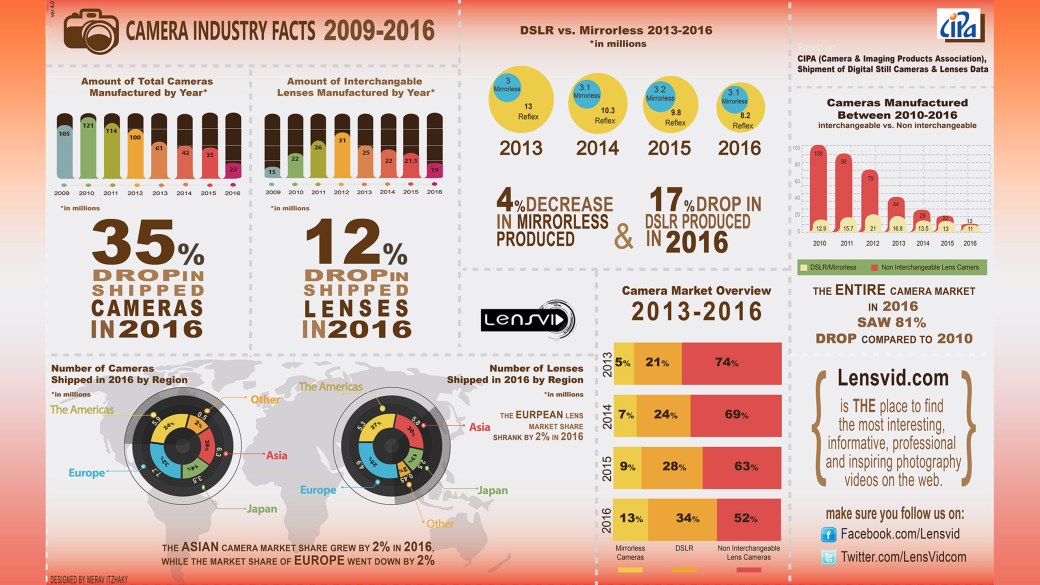
In 2010, Mirrorless cameras were not disaggregated, DSLRs about 13 million and falling, Compacts about 121 million, so 134 million cameras total. US dollar wise $11.9B compacts, $3.4B DSLRs for a total of $15.3B
In 2016, there were 3 million Mirrorless cameras sold, DSLRs about 8 million and falling, Compacts about 12 million, so 23 million total. US dollar wise $1.4B compacts, $2.3B DSLRs, 867M Mirrorless for a total of $4.5B
Doom and gloom? It depends who’s asking. Camera manufactures, suppliers, distributers, wholesalers, retailers are all impacted. All previous predictions underestimated the fall off in camera sales. Sales of compacts has fallen off a cliff and will continue. DSLRs and Mirrorless cameras will be their main source of camera revenue. But what does this mean for camera and lens buying photographers? Not much really.
- Select your brand carefully. The financial health of the camera company is also a factor a buyer should now consider before buying into a system. Don’t buy a camera from a manufacturer that is in danger of going under. If Samsung can close their camera division, this foreshadows tough times for the survivors. Samsung is 20% of South Korea’s GNP so they have tons of money. If they can’t make their camera division work…
- Stick with Canon. Sony’s camera division will probably continue on too. Nikon, not so sure, I’d have to look at their financials. Their product management and customer service are both terrible. The D600 debacle. The Keymission line is a joke. The cancellation of the DL line. The D400/D500 5 years late. Fuji? Don’t know.
- Though the standard manufacturers warranty is only one year, having the manufacturer in business ensures you have someone to send your camera to if it breaks, new lenses will be developed that fit your camera bodies lens mount, ????
Why the big fall off in sales? A combination of several factors:
- First and foremost is the invention of the iPhone making it easy to take pictures with something that fits in your wallet and that you always take with you. With an iPhone in your pocket, do you really need to take a dedicated camera?
- The iPhone lead to apps that facilitate sharing like instagram,
- The rise of photosharing sites like photos.google.com, picasa, flicker, etc
- The rise of social media sites like myspace, Facebook, twitter
- The internet, photosharing sites, iPhone, photosharing apps, fundamentally changed the workflow of taking and sharing videos from blah to blah.
- This left traditional camera manufactures out of the loop and they still haven’t caught up. I predict they never will. How could they unless they make a phone.
- No need to upgrade since the new cameras are not that much better.
- Extremely poor management, lack of response to a changing industry.
- Technology is good enough
It is not just the camera manufacturers that are having problems. The entire photographic industry is going through a massive transformation. Smart phones have obliterated the compact digital camera and probably eaten into DSLR sales too. Several manufacturers are laying off and cutting back production due to the decrease in sales. Panasonic and Nikon both announced layoffs while Go Pro has had a layoff in 2016 and again in 2017. Camera stores are going under. Even photography educational institutes are closing up shop with Brooks Institute closing in October 2016 due to a massive drop in enrollment.
Why?
 Canon M Cameras