State of the camera industry

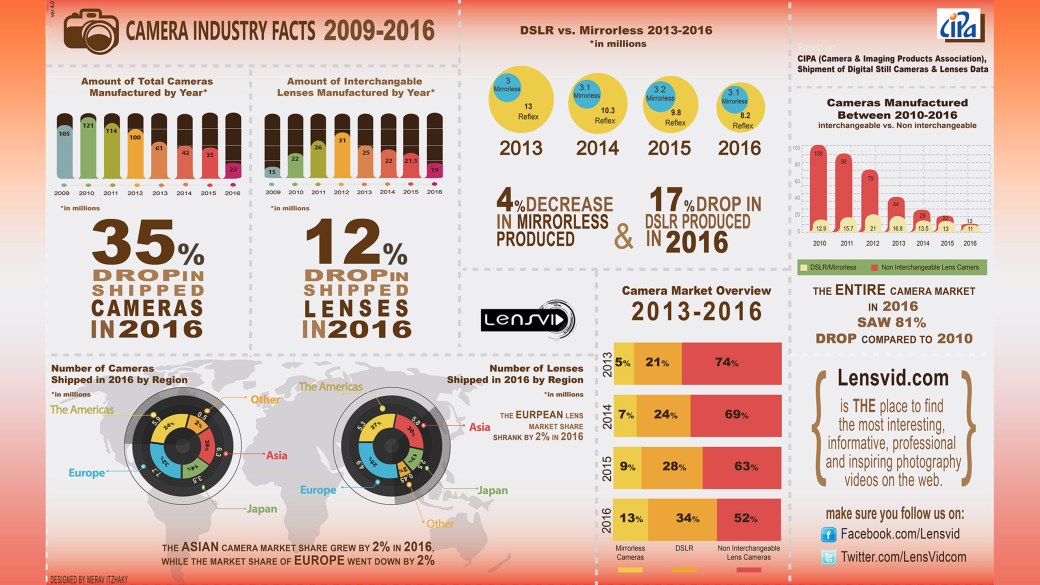
The camera industry has seen declining sales and revenues for several years. When the iPhone was introduced in 2007, camera sales were a $15 billion dollar industry. Then sales started falling off a cliff and in 2016 only $4.5 billion worth of cameras sold with no clear path to growth. Lensvid produced the graphic below:
Infographics-2016

In 2010, Mirrorless cameras were not disaggregated, DSLRs about 13 million and falling, Compacts about 121 million, so 134 million cameras total.  US dollar wise $11.9B compacts, $3.4B DSLRs for a total of $15.3B

In 2016, there were 3 million Mirrorless cameras sold, DSLRs about 8 million and falling, Compacts about 12 million, so 23 million total.  US dollar wise $1.4B compacts, $2.3B DSLRs, 867M Mirrorless for a total of $4.5B

Doom and gloom? It depends who’s asking. Camera manufactures, suppliers, distributers, wholesalers, retailers are all impacted. All previous predictions underestimated the fall off in camera sales. Sales of compacts has fallen off a cliff and will continue. DSLRs and Mirrorless cameras will be their main source of camera revenue. But what does this mean for camera and lens buying photographers? Not much really.

  1. Select your brand carefully. The financial health of the camera company is also a factor a buyer should now consider before buying into a system. Don’t buy a camera from a manufacturer that is in danger of going under. If Samsung can close their camera division, this foreshadows tough times for the survivors. Samsung is 20% of South Korea’s GNP so they have tons of money. If they can’t make their camera division work…
  2. Stick with Canon. Sony’s camera division will probably continue on too. Nikon, not so sure, I’d have to look at their financials. Their product management and customer service are both terrible. The D600 debacle. The Keymission line is a joke. The cancellation of the DL line. The D400/D500 5 years late. Fuji? Don’t know.
  3. Though the standard manufacturers warranty is only one year, having the manufacturer in business ensures you have someone to send your camera to if it breaks, new lenses will be developed that fit your camera bodies lens mount, ????

Why the big fall off in sales? A combination of several factors:

  1. First and foremost is the invention of the iPhone making it easy to take pictures with something that fits in your wallet and that you always take with you. With an iPhone in your pocket, do you really need to take a dedicated camera?
  2. The iPhone lead to apps that facilitate sharing like instagram,
  3. The rise of photosharing sites like photos.google.com, picasa, flicker, etc
  4. The rise of social media sites like myspace, Facebook, twitter
  5. The internet, photosharing sites, iPhone, photosharing apps, fundamentally changed the workflow of taking and sharing videos from blah to blah.
  6. This left traditional camera manufactures out of the loop and they still haven’t caught up. I predict they never will. How could they unless they make a phone.
  7. No need to upgrade since the new cameras are not that much better.
  8. Extremely poor management, lack of response to a changing industry.
  9. Technology is good enough

It is not just the camera manufacturers that are having problems. The entire photographic industry is going through a massive transformation. Smart phones have obliterated the compact digital camera and probably eaten into DSLR sales too. Several manufacturers are laying off and cutting back production due to the decrease in sales. Panasonic and Nikon both announced layoffs while Go Pro has had a layoff in 2016 and again in 2017. Camera stores are going under. Even photography educational institutes are closing up shop with Brooks Institute closing in October 2016 due to a massive drop in enrollment.

Why?
Tripods

The tripod I recommend for the M series cameras is the Sirui T-025X Carbon Fiber Tripod with C-10S Ball Head. This is an outstanding tripod and works perfectly for mirrorless cameras. Available from BandH or Amazon, you can’t go wrong with this tripod. I don’t recommend anything heavier since it’s really not necessary unless you are shooting in really windy conditions.

You’ll also need a tripod plate to attach to your camera so you can attach to the tripod head. For $20 you can’t go wrong with this plate from Promediagear.


What lenses should I buy?

I’d recommend buying the native EF-M lenses in this order:

  1. 18-55 or 15-45
  2. 11-22
  3. 55-200
  4. 28mm Macro

Native lenses are produced by the same manufacturer as the body. For the M series, the native lenses are Canon EF-M lenses.

Skip the manual focus third party lenses unless you absolutely need them. The Samyang and Rokinon fill a gap for fast prime lenses but I expect Canon to catch up within a year or two. The 18-55 or 15-45 will be the lens used most often followed by the 11-22 and then the 55-200 if you are an outdoor landscape or travel photographer. The Macro lens is a great lens and an affordable price. The only question is if you like doing close up photography. I hadn’t done any until I bought this lens and now I see macro type shots out in nature that I never did until I owned this lens. Note that a DSLR macro lens will be $400-$900 while the EF-M 28mm is only $300.

Note there are other brands that make EF-M lenses besides Canon. Rokinon makes 8 and Samyang has 7 primes for the EF-M mount filling the fast primes hole in the Canon EF-M lens line up. These lenses are manual focus. Tamron also makes two AF zooms: a 14-150 and 18-200 in the EF-M mount. These are auto focus. I can’t speak from experience since I haven’t bought or used any of these lenses but at least you have an alternative if you need a fast prime. You can always mount a Canon EF lens with the adaptor too.

Mirrorless or DSLR?

9/22/19 Currently under construction…

3.19.22

I’d recommend mirrorless. Canon, Lumix, Nikon are all great choices.

There are numerous blog posts and youtube videos regarding this topic, but DSLRs and their corresponding lenses will not get updated. I think the Nikon D780 will be the last DSLR from either Nikon or Canon.

It doesn’t matter that much. You can get great images with either. Mirrorless is newer and companies seem more committed to that platform since it seems to be accepted that its the future and is marginally better than a DSLR with similar specs. Full frame native lenses are more expensive than their DSLR counterparts. However, we won’t be seeing new DSLRs being introduced nor any new EF or F mount lenses.

—————————–

If you own several lenses either APS-C or full frame and you want to continue using them with the new camera then you have to buy the same brand. The new mirrorless lenses are better than older DSLR lenses so I’d recommend selling all your old gear and buying new. That’s what I did.

Deciding between a DSLR and Mirrorless is as important as the brand you select. 2019-2022 is a transitional state for both Nikon and Canon. They both introduced full frame mirrorless camera lines but have only 3-5 native mount lenses available. Most likely you will use an adaptor to get the EF or F mount lenses you want to use in the new mirrorless camera. Once there is a large selection of popular Z and RF mount lenses the discussion will change. For now though you will have to adapt EF or F mount lenses.

I’m leaving Sony and Panasonic out of this discussion

The inherent pros and cons in either aren’t really enough to sway most buyers one way or the other

Mirrorless

the lcd showing approximate exposure is helpful

Lighter

Smaller

no mirror lock up to remember to engage

Another feature of the Canon R series is the LCD is movable. This allows the photographer to tilt it to a comfortable viewing angle especially useful when shooting overhead or down low. If shooting in public around a lot of people I’ve noticed that they don’t know you are shooting video or pictures since your eye isn’t stuck to a viewfinder. This feature is not inherent to mirrorless cameras though

Trade offs with IQ no longer exist. In theory. My EOS R had terrible dynamic range compared to my 5D Mark IV so bad that I sold it

An APS-C mirrorless and APS-C DSLR will give you equivalent image quality.

When comparing brands and models this discussion gets much more complicated, but generally the lighter, smaller, no mirror to lock up advantages all hold true. For Canon M specifically, less expensive, easy to use, great IQ are also all pros of the line.

If you are shooting sports and need the fastest AF and FPS possible, then DSLRs would be the best choice, a Nikon D500 or Canon 7Dii

In the film days I shot a Nikon EM, 8008, 8008s, N90, N90s, F100, F4, F5, Canon Rebel, Canon EOS 1. All great cameras! When digital came of age, I shot with a Nikon D100, D200, D300, D300s, D70, D80, D90, D7000. Nikon fell behind Canon in the video department so I bought a Canon T2i in 2010 and never shot my Nikons again. I sold all my Nikon gear between 2011-2014. It took a while to get rid of everything. Since 2010 I’ve bought and shot a Canon T2i, T3i, 60D, 70D, 6D, and 5Diii. I’ve loved all these DSLRs but never enjoyed hiking or traveling with them. The weight, bulk, and expense was always a chore. It got so that I didn’t enjoy my photography as much and considered it a chore. I then bought a Canon M in 2014 and a Canon M3 in 2015. The M3 has been my favorite camera from 2015-2019. It was essentially a backup camera at first but then became my primary camera after I saw some 12×18 enlargements and a 20×30. The IQ is as good as an APS-C DSLR and as good as a Full Frame DSLR at 12×18.

If you’re just starting out and mainly shoot pix on your iPhone and want a dedicated camera, I recommend a Canon M50.

Do DSLRs have any advantage? Comparing to the Canon M line, the EF DSLRs have a much larger lens selection. Generally bigger buffers, faster AF and FPS.

Another reason to shoot mirrorless, or specifically the Canon M series is the cost. Do you want to be walking around in a country you’ve never been to and don’t speak the language where what’s in your camera bag is equal to the average workers annual salary? I don’t. An M system can be had for $1350 and can all fit in a small camera bag. M50 w/15-45 $650, 11-22 $350, 55-200 $350 = $1350 buys you an amazing system with a lens to cover any focal length. Add in the 28mm macro and you’re all set.

Canon M isn’t for everyone

Wedding photographers – The Canon M series is not an ideal camera for everyone. If at some point in the near future you plan to shoot a wedding and get paid for it, I would recommend a DSLR. The size impresses people who don’t know anything about cameras.

Videographers – who want to shoot and get paid, who want full sensor 4K or need all the rigs, cine lenses etc will be better off with a Canon DSLR or EOS R, RP, Panasonic GH5, or Canon Cinema camera.

Sports and action photographers – Long telephotos, 10FPS, lots of AF points, are better off with a Canon 7Dii, 80D, or Nikon D500.

Art – enlarging to over 24×36 would probably be better with a full frame camera of 24mp or more.

Conclusion:

If you are currently shooting with an iPhone, I recommend getting an M50 system first, then if you want to enlarge your images to 24×36 or larger and are critical about image quality, a full frame Canon 6D Mark II, 5D Mark IV, Nikon 800, 810, or 850 or mirrorless Canon EOS R, RP, or Nikon Z6, or Z7 would be a good addition. Do you need to stay with Canon? Not really. The lenses are not compatible though you can use an EF lens on an M body with and adaptor but there are so few instances where you would prefer to do this. The speed lights are 100% compatible, remotes might be compatible,  and possibly the battery and charger if you get an RP but other than that you don’t gain much by sticking with Canon FF if you own an M system.

Depreciation

One thing to keep in mind when purchasing camera equipment is depreciation. Whatever you buy today will be worth less tomorrow. If you buy a body new, especially an expensive one the value will depreciate. When Canon 5Diii’s were selling for $3499 I bought one for $2800 refurbished. I thought I got a great deal. Two years later even before the 5Div was released I sold it for $1900. I didn’t even use it since I owned a 70D and 6D at the time. Did I get $900 of use out of it? Nope. Using the 5Diii I learned that it was way more camera than I needed. The AF options were intimidating. I was much happier with my 6D for landscapes and 70D for action and telephoto shots.

Whatever camera you want to buy, compare the used and new price. You might be better off buying a used one.

Since the body of an M3 is $479, M6 $779, M5 $979 a buyer won’t lose more than $200-$300 on a sale of a 2-5 year old body from the new price. A great deal!

Weather sealing

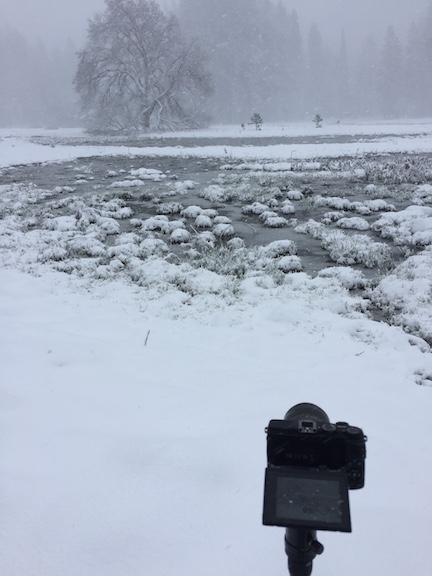
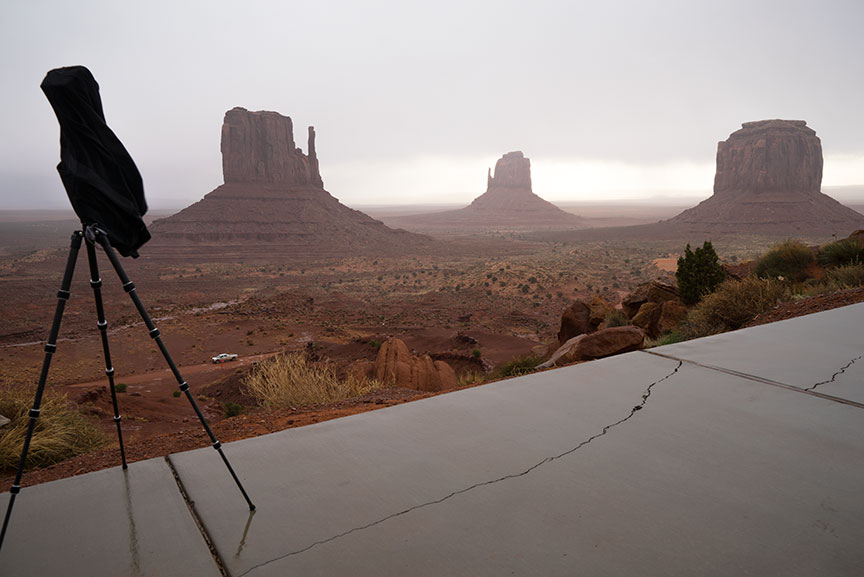
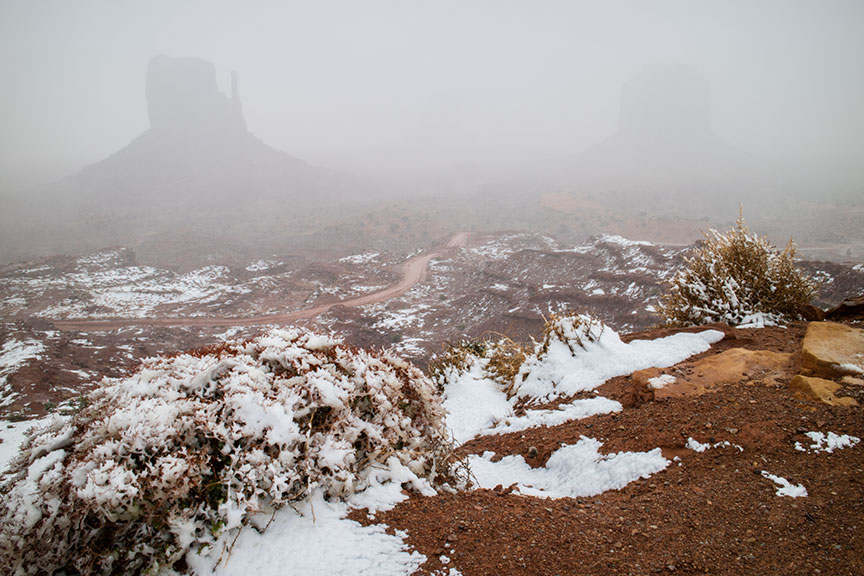
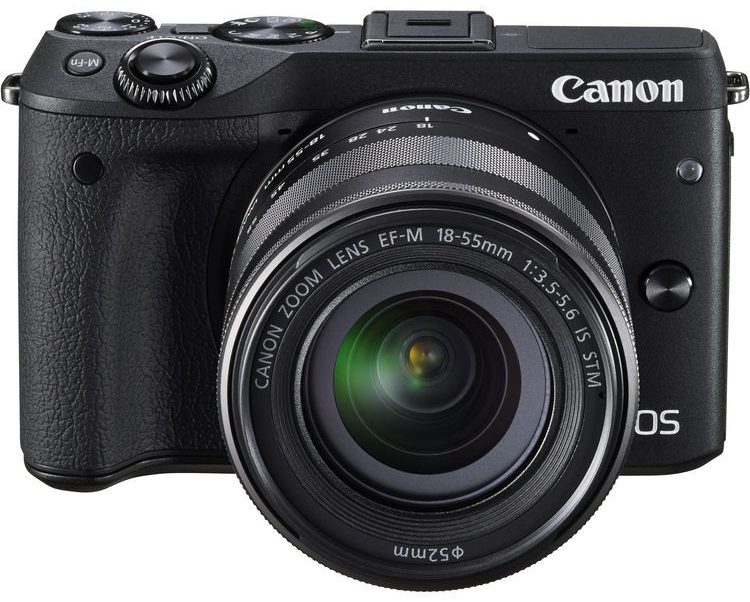
Weather sealing is an over rated feature. The Canon M3 is not weather sealed. I’ve shot my M3 in the rain and snow of Yosemite and Monument Valley and haven’t had a problem. Just don’t change lenses if it’s dusty or windy! The main problem is keeping rain drops and snow flakes off of the lens. Keep a dust cloth handy for this. Still, if it’s raining and snowing hard, it’s difficult. An umbrella and assistant can come in handy. Note that the M5 viewfinder eye sensor is really sensitive and if a rain drop gets on it the LCD will black out. This was a problem since I use the LCD exclusively now and when it rains the M5 will black out the LCD. There may be a workaround, but I didn’t find it.

IMG_4959.6x8

Shooting in Yosemite Valley March 5, 2017. It was snowing and in the 30’s F but the M3 had no problem. Use the remote release so you don’t have to touch the camera.

DSC00006

Shooting in the rain and below freezing temps. I just threw a pair of Nike Dry Fit shorts over the camera waiting for the weather to clear and the light to get better. A few minutes later the temps dropped even more and it started to snow. The monuments were obscured.

IMG_4274

The bottom line is that a weather sealed body is not really needed for outdoor photography in the rain and snow. For dusty and sandy environments like Antelope Canyon or Death Valley the M3 also did fine. However, bring Ziplock bags in your bag if going to sandy areas. You may encounter a sandstorm and need to zip everything up quickly.