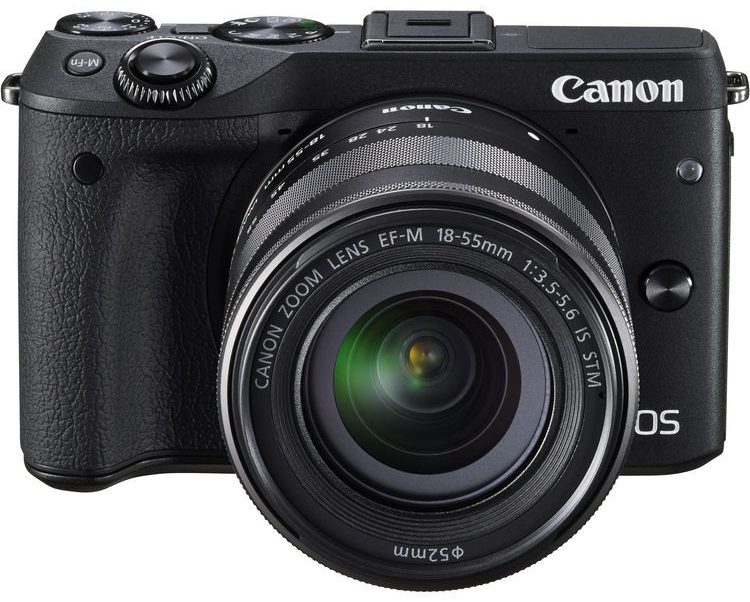
dpreview is getting less and less useful to the point I turn to other sites for info.
- Still camera quality is already so high that personal preference will make the most difference in whether a camera suits a photographer. One line about how Sony’s UI could be improved in a review doesn’t do it justice. Once I owned and shot with a Sony A7r and A6000 and struggled through the menus then I got it. Personal experience and use is the way I figured out what camera body to buy and stick with.
- The end product being a print online or a 4×6 to 20×30 will not be significantly influenced by the brand or model as long as the camera bodies are using the same sensor size, 4/3, APS-C, or full frame.
- The smartphone camera take over of the point and shoots and low end DSLRs will also impact dpreview. Less cameras to do reviews for as manufacturers cut back to a line that has only 10-13 camera models. Three APS-C mirrorless bodies, 3-5 DSLR bodies, and 3-5 FF mirrorless bodies. This number of 10-13 models will stay fixed over the years with less frequent updates. Now that the megapixel upgrade period is over users will figure out that current AF technology is plenty fast and accurate, and that they don’t need 4K, 6K, or 8K video to shoot stills. Consequently they will keep their camera bodies for 4-8 years like back in the film days. Users who do shoot high res video will buy cameras suited for video like the Lumix GH5 or Canon Cinema Cameras.
- The end to the bull market and looming recession will hit the photo industry hard. This might cause some contraction within the industry. These new full frame mirrorless camera lines are so expensive that high end phones like the iPhone 11 Pro and APS-C camera lines with their much less expensive bodies at $400-$879 and lens pricing from $300-$500 will dominate sales. Look at the current line of RF lenses. How many do you plan on buying? At $1000-$3000 I’ll pass.
- Consumers will figure out they don’t need a dpreview review before they buy a camera or phone. I for one will buy an iPhone 11 Pro regardless of what a review says. The same goes for a new body in the camera line I currently own. Could there be anything in the review that would sway me from the iPhone 11 Pro to buying a Pixel or Galaxy or Sony A6xxx? No. The quality is so high and feature set so rich. Moreover I can depend on customer service to fix and issue with an iOS or firmware update.
- Poor to non existent moderation in the forums. I’m guessing moderators aren’t paid well, are burned out, and have few to no automated tools to scan for abusive posts.
For an example of poor moderation. The actual question posted was:
https://www.dpreview.com/forums/post/63058986
I’d like your opinion:
1) Why doesn’t Nikon have a mirrorless APS-C camera line ?
2) Do you think Nikon will launch a mirrorless APS-C camera line in the future?
The responses were: 1) Only Nikon knows, 2) lack of resources, 3) will do it in the future but wanted to do FF first, 4) because I wouldn’t buy one, 5) they are going to do an APS-C Z mount camera, 6) and my personal favorite, “you don’t need an APS-C sensored camera.” That post started an argument between the poster and another guy and they went back and forth until the thread got locked. Why not just delete their argument and send them a warning or delete or lock their account? If these answers were being graded they would get a D or F. Why? They don’t answer the question or support any of their answers with sources or any understanding of the backstory. Granted, the backstory below was not posted, but the posters don’t recognize the opportunity that Nikon is missing out on or a memory of the failed Nikon 1 and Key Mission lines. Assuming that those resources could have produced the APS-C mirrorless line makes their failure sting even more.
Backstory to this question. The Canon M was introduced in 2012. The M6II in 2019. There are 8 EF-M mount lenses and with an adaptor dozens of EF and EF-S lenses can be used on an M body. The Sony A6000 was launched in 2014 and the A6600 in 2019. Sony has 7 E mount lenses designed for the APS-C sensor and can use dozens more E mount lenses designed for the full frame A7 series. Both Canon and Sony have found success with a mirrorless APS-C camera and lens line. It’s a mystery why Nikon hasn’t done the same. They discontinued the Nikon 1 and KeyMission lines since both were terrible ideas that didn’t sell, yet a mirrorless APS-C line clearly would sell and can be positioned exactly like the Canon M line, a cheaper, more compact camera line compared to the FF mirrorless but is compatible via an adaptor with all the DSLR lenses. It’s a great gateway into a DSLR or FF mirrorless camera, but can also be a standalone system where a photographer may own just the EF-M system or both an EF-M system and an EF or RF system. Note that this is a different market audience than an mirrorless APS-C sensored Canon R or Nikon Z body. The DSLR equivalent would be a Canon 7D Mark II or Nikon D500.
This is the most popular website for camera and lens info. If you propose a question, you might get valuable and insightful information in response, or something whiny, nitpicky, hostile, argumentative, and abrasive. Different forums have different groups of people in them. The Canon M forum is usually pretty good. Often there are trolls who will do nothing but stir up trouble and attack a positive camera review and point out all the flaws in the camera and the poster’s assessment of it. Negative reviews will bring out as many contradictions as the positive ones. Commenters will point out how the reviewer’s assessment was flawed to the point that they are not entitled to their opinion. Free speech or hate speech? Constructive criticism or online harassment and bullying? My experience is the moderators do a totally inadequate job. To be fair, I don’t see the many threads that they delete, but two I have posted have been deleted or locked due to abusive commenters. Wouldn’t it be simpler and more effective to delete all the abusive commenters, warn them, and if it happens again ban them?!
Chris Nichols at Dpreview said that Nikon will be dropping 5 lines of DSLR at around 6:45 of this video. Sure, we could have guessed that the Df and D610 would be discontinued and perhaps some more, but 5? If this is true, we can guess that it won’t be the D6, D850, D750. So that leaves the Df, D610, D3xxx, D5xxx, and D7xxx. If so, they really need an affordable mirrorless line to make up for the loss of those lines and price points for their customer base.
According to bcnretail.com,
“Although the market leader has been surrendered to mirrorless single-lens cameras, SLR has a large lineup of interchangeable lenses with many users. It is an annoying problem how to make a sector that still generates more than 30% of sales. New development will be difficult, except for flagship models that can be expected by professionals such as news media and models currently under development. The lens is the same, and it will gradually fade out in the future. The big point for the market is how to further accelerate the SLR-free “mirrorless” SLR. As of March, the majority of sales in the interchangeable-lens digital camera market accounted for 51.2%, with a mirrorless interchangeable-lens camera equipped with a sensor of less than full size. This is the largest volume zone for interchangeable lens digital cameras. This lineup enhancement will be extremely important for maintaining the interchangeable lens digital camera market.
Canon, which is performing well even with a mirrorless interchangeable-lens camera, absorbs the needs of the volume zone with the EOS M100 and EOS Kiss M, which are popular with the EF-M mount. It continues to run the top share. But the full size model is another RF mount. Since there are three systems: single lens reflex EF, mirrorless APS-C EF-M, and full-size mirrorless RF, there are concerns about the spread of development resources.On the other hand, Sony, which can cover both full-size and APS-C with the same mount, launched the relatively inexpensive α6400 in February and expanded the volume zone lineup. There is no lack of user acquisition. The most problematic is Nikon. With a mirrorless interchangeable-lens camera, there is still only a high-priced Z6 / Z7, and there is no tray for a volume zone of around 100,000 yen. There is an urgent need to increase the lineup.
For the entire market, the mirrorless single-lens lineup that can be completely replaced by single-lens reflex cameras is still insufficient. Enhancement is essential. Now that the user’s mind is moving away from the camera, there is little time left for market recovery.” (BCN, Ichiro Dogoe)
The google translation can be difficult to understand but several points stand out:
- DSLRs are dying, but how do we increase the market for mirrorless?
- As of March 2019 half of all ILC sales had sensors smaller than full frame, so I assume predominantly APS-C and Micro 4/3’s.
- Canon has the most market share of this smaller than Full Frame sensored cameras with their EF-M system
- Sony did well having one mount covering both the APS-C market and Full Frame market.
- Nikon only has the expensive Z line of mirrorless Full Frame cameras so an APS-C solution is urgently needed
If Nikon really is discontinuing 5 lines and if those lines include the D3xxx, D5xxx, D7xxx they will need something to replace that revenue. A mirrorless APS-C solution with an enhanced F mount would make the most sense. My proposal would be a three body line similar to the M100, M50, and M6 Mark II. Use the current 24MP sensor in the first 2 bodies and a new 30+MP APS-C sensor in the flagship model and the APS-C Z camera body. I’m not a camera engineer, but if it could use an enhanced F mount that is compatible with all the current 26 Dx and 77 FX mount lenses. Then enhance it with increased functionality, something like the RF lenses then that would be a huge win. Launch a limited line of enhanced Dx lenses that are native to this new mirrorless line, but will also work on Dx DSLRs and FF DSLRs. A wide angle zoom 11-22, a standard zoom 18-55, and a 55-200. Then a macro lens and some primes. These should be L quality since standard quality are readily available in the Dx lens line.
So that’s the backstory and my proposal. The actual question that I posted was:
https://www.dpreview.com/forums/post/63058986
I’d like your opinion:
1) Why doesn’t Nikon have a mirrorless APS-C camera line ?
2) Do you think Nikon will launch a mirrorless APS-C camera line in the future?
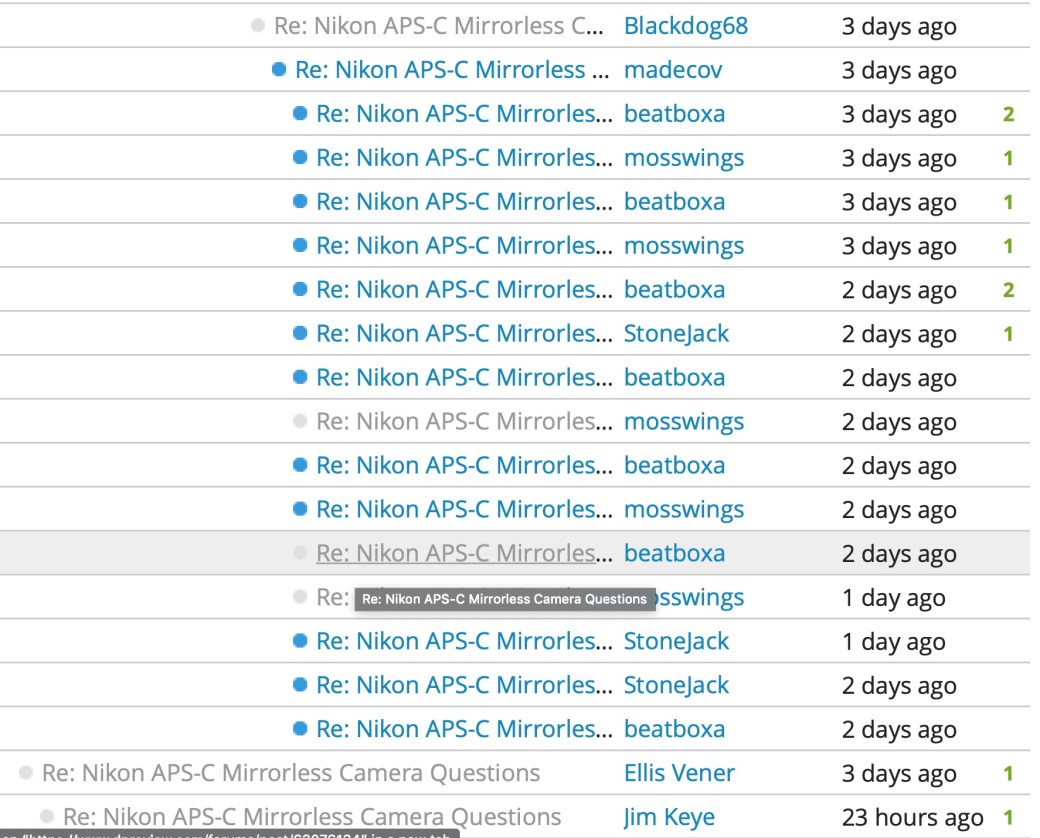
The responses were: 1) Only Nikon knows, 2) lack of resources, 3) will do it in the future but wanted to do FF first, 4) because I wouldn’t buy one, 5) they are going to do an APS-C Z mount camera, 6) and my personal favorite, “you don’t need an APS-C sensored camera.” So if these answers were being graded they would get a D or F. Why? They don’t answer the question or support any of their answers with sources or any understanding of the backstory. Granted, I didn’t post the backstory above, but the posters don’t recognize the opportunity that Nikon is missing out on or a memory of the failed Nikon 1 and Key Mission lines. Assuming that those resources could have produced the APS-C mirrorless line makes their failure sting even more. Anyways, Blackdog68 and beatboxa got into an argument about a related but off topic issue and just went on and on until the moderator locked the thread on 9/10/19. Great. Why not just delete their argument and send them a warning? Anyways, I got no insightful or well thought out and researched answers.
My best guess? Poor management. They clearly had the resources but allocated them to the 1 and KeyMission. Doing FF first makes little sense. APS-C is cheaper. Those customers could then upgrade or just add in the FF mirrorless later. An APS-C Z mount camera is an interesting idea but doesn’t really address the original question. All I can come up with is poor management, like not ever releasing a D400 or denying the D600 had a problem. As far as releasing an APS-C mirrorless line that is not based on the Z mount but is similar to the M or A6000 series will probably not happen now. Nikon is too late to the game too effectively compete with Canon and Sony. They would also have to match Canon’s megapixel count of 32.5MP in their flagship otherwise they will look behind the competition at launch. Is there a 32.5MP APS-C sensor available for Nikon to use? If they launch with the current 24MP sensor they are using in their Dx DSLR line, that will be okay as long as the flagship can match Canon. Both Canon and Sony seem to be too far ahead at this point with new bodies and lenses launching in Sept 2019. Still, if an enhanced F mount APS-C sensored mirrorless camera line could be launched by Nikon in 2019 I still think it could be successful if it follows the path outlined above.
 Canon M Cameras