I love riding gravel. The challenge is really distance and not elevation or avoiding and negotiating obstacles. There’s great scenery, very low probability of crashing, but what I don’t get? Gravel bikes. Basically road bikes with slacker geometry, longer wheelbases, hydraulic disc brakes, frames with more tire clearance, fatter and knobbier tires. So a rigid 29er with drop bars and skinny mountain bike tires is a quick way to describe them. I get some people love these bikes and some hate them. I am neither. I think they’re great since they give roadies who love drop bars a bike that they can ride on dirt roads. They also produce a valuable revenue stream for bike companies since the mountain bike craze that started in the late 80’s to 90’s has died down and most people can’t afford e bikes.
I like this youtube channel called Pathless Pedalers.
When I ride the gravel paths near where I live, I use 2-3″ of travel on my 100mm fork and 2-3″ on my rear shock. I’m using 1.85″ tires with 30-40 psi. Imagine a rigid gravel bike over the same terrain. Supposedly faster on the asphalt but what about the other surfaces? What if speed isn’t an issue? A full sus bike with gravel tires will be more comfortable guaranteed. The rear tire will stay connected to the ground more. I’d rather have comfort and control. Where does that 3″ of travel go when I switch to a rigid bike? Ouch, right through my hands, wrists, arms and up my feet, ankles, and legs resulting in momentary the loss of control and traction. No thank you. Still, I’m glad the bike industry has a new hot seller.
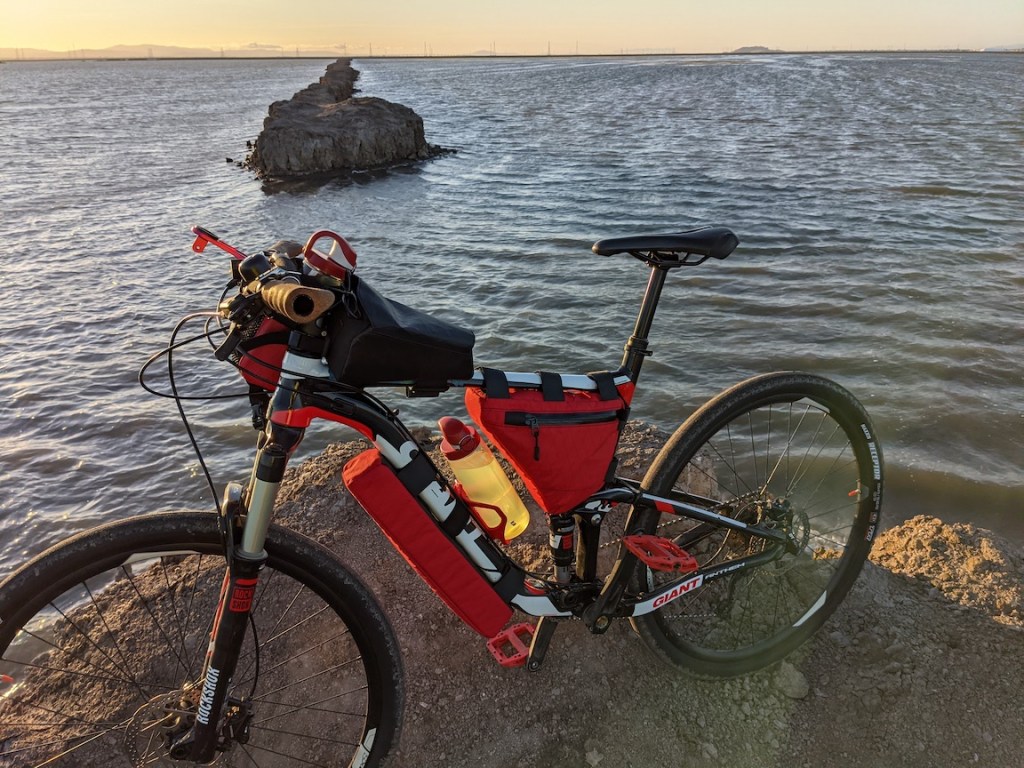
You can make a gravel bike. Start with a used XC mountain bike in a 27.5″ or 29er. Put gravel type tubeless tires on it. Convert to drop bars if you absolutely don’t like flat bars. Convert to 1x if you prefer. Done. Your bike will have twice as much travel as a new gravel bike that is currently on the market. You’ll save $1000’s. Here is mine below.
A new gravel bike hit the market in 2020, the first full suspension gravel bike when almost all gravel bikes are rigid. The Niner MCR 9 RDO.
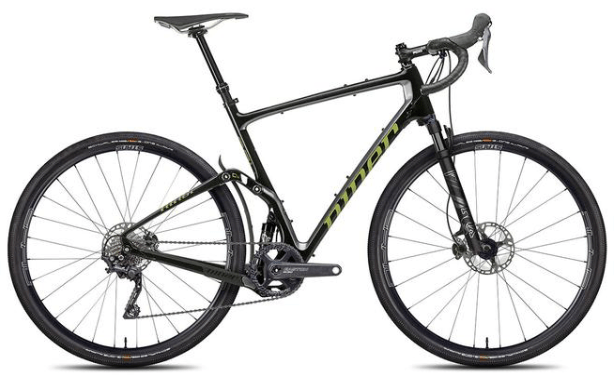
I was going to buy it and convert it to a flat or Jones bar and a 1x set up. Six reasons why I didn’t buy it:
- Couldn’t find a Niner dealer in my state that had one that I could test ride and when I emailed them, they didn’t seem all that motivated to order one for me to try out.
- Emailed Niner twice with some questions and received no answer. I guessed correctly at the CEO’s email address, emailed him, and his response was well…. very underwhelming. Note that this is a $4600-$7700 bike so more money than most would ever spend on a bike.
- Rode my XC bike out to the gravel trails I usually take and found I use 2-3″ of travel in the front, so what happens when I run out of travel on the $800 Fox AX fork after I’ve maxed out the 40mm of travel on it? 40mm of travel just seems so 90’s when the first Rock Shox forks had 48mm of travel. All XC bikes have 100mm or more in 2021.
- The reviews, in particular this one from Cyclingtips. The response from the product manager also did not persuade me to buy one.
- Niner went bankrupt in 2017 but was bought in 2018.
- Ultimately riding my Anthem with Receptor tires and using 2-3″ of travel sold me on not buying a rigid 29er gravel bike with no or limited travel suspension.
Speed test: Since the majority of my riding is on gravel and flatter dirt trails a gravel bike with flat bars would be ideal I would guess, but it’s really not, here’s my research methodology and findings:
I bought a 29er hardtail, a 2021 Giant XTC. I put 700×40 Maxxis Re-fuse slicks on it and doing my 1.67 mile/ 2.68 km ride around the block wasn’t any faster at 9.42 compared to my XC mountain bike with knobbies at 9:10-9:39. I then swapped out my knobbies for Maxxis Receptor 650 x 47 gravel tires and got that time down to 8:44 so the bigger wheel size and rigid rear triangle didn’t make me any faster, nor did the full suspension slow me down. These results contradict popular opinion so I’d recommend running a test like this yourself. So a 29er hardtail on gravel or asphalt isn’t faster than my 27.5″ wheeled full suspension with slightly wider tires. The full suspension bike definitely feels more comfortable and it fits me better though both frames are a large and from the same brand, Giant. I really didn’t have to trade off comfort for speed, though speed isn’t really a consideration.
If you like riding gravel, consider a full suspension or at least a hard tail mountain bike with 40-47 wide tires. A Giant Anthem or XTC would be good options.
I expect future gravel bikes will have a front suspension fork and the highest end models will have full suspension with limited travel to differentiate them from mountain bikes. So 60mm forks instead of 100mm or more. More companies will spec flat bars too. Not sure where this will all end up in 5-10 years, but I’m guessing they survive.
Since bikes are designed for a particular purpose, if the terrain you ride on changes from smooth asphalt, to rough asphalt, to smooth gravel, large loose gravel, hardpack, loose over hard single track, all on the same ride as mine does, any bike will be a bit of a compromise. The road bike will be fine on the asphalt, but that’s really all it’s good for. The gravel bike will be fine on the asphalt, and smooth gravel, but the big gravel and single track will be difficult, bumpy and uncomfortable. The full suspension mountain bike may be slower on the asphalt, but if you install Maxxis Receptor or Re-fuse tires, your bike will eat up the gravel and single track in comfort, so that’s the alternative I pick.
 Canon M Cameras