The goal of this page is to provide the reader with valuable information to consider before purchasing a mountain bike, especially their first mountain bike. I’ll add in pictures at a later date.
If you want to buy your first mountain bike, this is what I recommend and why:
- Q: What’s the difference between a hard tail and full suspension bike? A: A hard tail has a front suspension fork, and a full suspension bike has both a suspension fork in front and a rear shock in back.
- Q: Should I get a hard tail or full suspension? A: The standard answer is it depends on the trails you ride. If you’re a beginner to advanced beginner and especially if this is your first mountain bike then I’d definitely get a hard tail. Advantages of a hard tail is they are usually $800-$1100 cheaper than a comparable full suspension bike. The skills you need to learn you can learn on a hard tail just fine. A 2017 Giant Fathom is $1000-$1400 and a 2017 Giant Anthem is $2000-$2600 so significantly more expensive. After riding a hard tail for several years and wanting to take more and more advanced trails, that would be the time to buy a FS bike. Don’t think that a FS bike is better than a hard tail and an upgrade from a hard tail. If you’re riding fire roads, climbing up hills and not jumping on rocks and roots then a hardtail is better than a FS bike. So it depends on what type of trails you ride. As a beginner or adv beginner, get a hard tail. I have both.
- Q: What brand should I buy? A: Giant, Specialized, and Trek are the big three in terms of sales and models available. I recommend Giant. There are 143 bike brands in the US, so why Giant? There is the school of thought that the bike is the most important factor and not the brand. Another school of thought is that your Local Bike Shop (LBS) is the key factor in determining your bike buying decision and not the brand. These theories all have merit, but since Giant has such a wide variety of models, 95% of new mountain bike buyers will find a bike that fits their needs perfectly though some minor mods might need to be made. Your LBS probably carries Giant, or maybe you have to drive 10-30 minutes to get to a dealer. It’s worth it. Why? Specialized, Trek, Niner, Santa Cruz design their bikes but then have Taiwanese and Chinese companies like Giant or Merida manufacturer their bikes. Giant is a Taiwanese company and they design and manufacture their own bikes as well as Trek, Scott and other brands in Giant’s own factories and pass the saving on to the consumer. This can be a savings of $500-$1000+ on a similarly spec’ed bike compared to Specialized, Trek, Santa Cruz, Scott, and Niner. Here’s an example: blah blah, so value is the main reason. If money is no object then sure, buy any brand that appeals to you.
What about the 140 other brands? They will be more expensive and I can’t imagine that Giant, Specialized, or Trek doesn’t have an identical bike, but if you like the ride and get a good deal on it, sure. The resale value will be less though. As you ride more, your taste may change in bikes so resale value of a big three is generally higher due to consumer brand awareness. For example, do a search for Stumpjumper on craigslist and see how many hits you get. I got 100. Now search for Spot Rollik 557. I got 1 hit.Source: https://www.cips.org/supply-management/news/2016/january/secret-giant-is-worlds-biggest-bicycle-manufacturer-and-still-growing/
http://www.bicycleretailer.com/opinion-analysis/2012/06/20/rick-vosper-whos-number-1#.WVE1I8aZOHo - Yeah but what if one of the 140 other brands has some new innovation that the big 3 don’t? Of course, product differentiation is their only attraction since it won’t be price since the quantities are so small. Doubtful that the 140 have something that the big three don’t that is significant. blah blah
- Q: New or used? A: It depends, but generally new, unless you find a great deal on a used bike like 50-60% off of the new price and it’s in really good to like new condition and it’s a recent model, model year 2014 or newer. This is possible since some buyers will buy a great bike, but ride it 2-6 times a year and not even in the dirt sometimes. New bikes can be so cheap that the price difference is no longer that big a deal. Used bikes have no warranty from the manufacturer. Used bikes often need $100-$500 worth of parts and labor that the savings gets smaller and smaller. Mountain bike technology has been moving rapidly since 20?? with new standards, geometries, components, wheel sizes, that I’d just get a new bike, though last years models you can save some money. Bike shops will often have models that are 1-3 years old still for sale on their showrooms floor. I know, bike sales must be slow or they just stock bikes that don’t sell for some reason. Not sure about this, but I’ve seen it in multiple LBS in my area.
I have bought several used and new mountain bikes since 2013 including Stumpjumper FSR, Hardtail, Camber Comp, 2004 S-Works Stumpjumper, Giant Seek 1, Giant Anthem 3, Giant XTC 2, - Stay away from older project bikes even if they are a real steal. For instance. I bought the bike below.
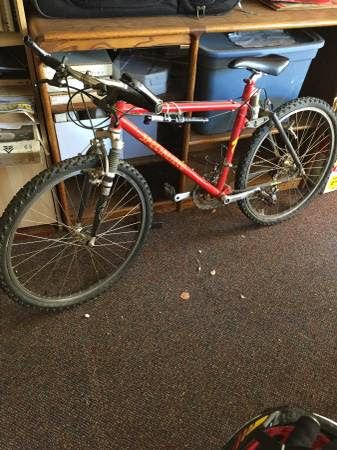 It was an amazing deal compared to new, I think they were $2000+ when new in 1994. I picked it up for $200! However, I spent another $300 on parts and labor to get it into the condition it’s in. After all that, it still has cantilever brakes that feel like crap compared to modern day hydraulics. The wheels are 26ers. The fork has an inch or two of travel and won’t hold air and is $100 to repair. The rear shock is okay, but if not would cost $100 to service. I wouldn’t ride this in the dirt. In fact, I knew this and set it up for the street. For $500, I could have put that into a new bike with disk brakes, 27.5″ wheels, a better feeling cockpit, etc. Still, I like this bike mainly because of the nostalgia factor and 23 years ago I couldn’t afford it though I really wanted one. Now I have one and it’s no big deal.
 - I would stay away from 26ers, cantilever or V brakes.
- Make sure to get 135mm spacing or wider. Boost spacing would be better.
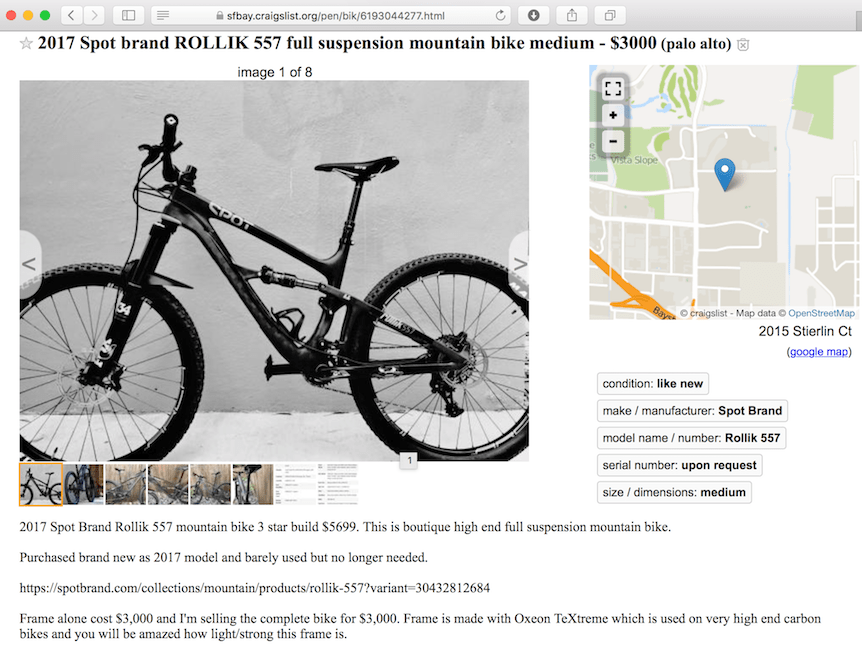
- Depreciation. Bought for $6000, trying to sell for $3000 but will take less. Yes, a new bike will generally depreciate 40-50%! This is the best argument to buy used of course is to save money. Just make sure to add in the parts and labor that the used bike will require to get back up to the condition you want it in. There are some great deals out there, but you have to be able to inspect the bike and make sure you get the bike shop receipt otherwise the bike could be stolen. If I were in the market for this brand, model, size and he had the bike shop receipt I would consider this a good buy.
- Q: What wheel size should I get? A: There are three main sizes, 26, 27.5, 29. I don’t recommend a 26er since 26″ wheeled mountain bike is difficult or almost impossible to find new. The only wheel size available since mountain bikes were invented in the 1980’s, this didn’t change for 30 years! in 2010? when 29ers came on the scene. Then around 2014 the 27.5″ wheel size became popular. Currently, the choice is really between the 27.5 and 29ers. Note 27.5 and 650B are often used interchangeably. Okay, so not a 26er, but how do I choose between the 27.5 and 29er? Test ride several models of each. One wheel size will stand out. A general guideline is you are over 6′ the 29er will be a good bet, under 6′ and a 27.5 will be the way to go, though this has exceptions. I prefer the 27.5er since they are easier and quicker to steer and control compared to the 29er.
A lot of weight seems to go to what wheel size a particular racer was using when he or she won some big race. I wouldn’t pay too much credit to this. Just test ride both wheel sizes and multiple styles of bikes. I actually bought used 26er, 29er, and a new 27.5er before zeroing in on the 27.5er as the best wheel size for mountain biking. I still have all three and they feel significantly different. - Q: Aren’t there more sizes than 26, 27.5 and 29? A: Yes, there are 26+, 27+ 29+, and fat bikes. Stick with a 27.5 or 29er since there are so many choices available in both brand, model, size. The + bikes I’m guessing won’t last in fact 29+ is already gone. The enduring sizes will be 27.5 and 29 with 27.5 taking 60-70% of the market in my prediction.
- What frame material should I buy, Steel, Composite, or Aluminum? Steel is difficult to find and you’ll have limited choices. Composite is probably the best for racing and people who care about weight. Aluminum is what I recommend for most riders. It’s $500-$900 cheaper compared to Composite for the same bike. What about steel or titanium? Titanium is prohibitively expensive and only a few bike companies even make titanium bikes. Steel is just as difficult to find on a new mountain bike. Stick with Aluminum.
- Okay, so frame material doesn’t make that much difference or isn’t really worth the money, then what make a big difference? Where is it worth it to spend money.
- What are these new standards, features, technology in the last 10 years? Well, shock sizes used to be all over the place and are getting more standardized. Bottom bracket types are still all over the map. Full suspension bikes have gone through so many iterations in the last 30 years, but that seems to have settled down to two main designs.
- What are these new standards, features, etc are important?
- Wheel size, 27.5 and 29ers
- Much longer travel. The first suspension forks had about 1″ of travel. They now have 4-8″ of travel
- 1x gearing. 3x gearing is really a joke. Explain how and when to shift the front derailleur and the rear derailleur to a neophyte. Now imagine them trying to figure this out on a rocky trail with switchbacks, short climbs and descents, and roots and potholes. Exactly. It’s too complicated. 1x is the way to go.
- Hydraulic disk brakes
- Flat studded pedals
- Handlebar width has widened significantly to blah blah from blah blah
- Cockpit. This is a hard one to explain, but the geometry of the frame, wheel size, stem rise and length, handlebar rise and width all construct the cockpit and how the bike feels and fits you.
- There are a ton of bottom bracket standards, rear hub spacing, but these won’t impact how your bike feels nearly as much as the items above.
What full suspension design is the best? Honestly, I wouldn’t worry about it too much. There are two designs that currently dominate the industry. One is where the rear shock is vertical and attached to the bottom bracket area. Giant, Scott, Trek all use this design. (What’s the technical name for it?) The other is where the shock is attached to the top tube and the shock sits more horizontal. Specialized, Santa Cruz,
Q: What’s the difference between an XC, Trail, Downhill, Enduro Mountain bikes? A: blah blah
How much does it cost to fix a bike? Suprisingly, it’s pretty inexpensive when compared to car repairs. Here is a price list from my local bike shop.
Should I do the repairs myself? Sure, you can self teach yourself with videos on youtube though some operations will require special tools. There are some tools you should have in your garage and in you bike bag when you ride including: blah blah
Does geometry matter?
What about drivetrains? Since 2014 when I created my first 1x drivetrain I’ve been a big fan ever since.
What’s the most important points to consider when buying a mountain bike? :Frame size, cockpit, personal fitting, does it feel right? You have to ride several bikes to get a feel for this.
Stem length and rise
Handlebar width and rise
Accessories on the bike
Brand
Tires
Grips
Saddle
Seat dropper
What am I doing and looking for on a test ride?
How much travel do I need?
Drivetrain 1x 2x or 3x? The number refers to the number of chainrings of the crank. 10, 11 or 12 in back? Refers to the number of cogs or gears in the cassette in back.
I would stick to a 1×10 or 1×11 setup. This may be counter intuitive since more gears is always better right? Not really. In this case a 1x set up is generally better because:
- It’s lighter since there is only one chain ring
- There is no front derailleur
- There is no front shifter or cable, leaving room for a remote for your dropper
- You don’t have to worry about shifting a front derailleur
- A 2x or 3x have so much overlap with a 1x that you really aren’t effectively missing many gears. See this chart: blah blah
- The hard to pedal gears for going really fast? These aren’t really needed for mountain biking since the probability of crashing when going that fast goes way up. If you’re headed downhill and it’s steep, you’re not pedaling, you’re braking. On a flat fire road you wouldn’t needed super hard gears to pedal since how fast can you possibly go? I have a 30t chain ring in front and an 14-42 in back. I still want easier gears. I can’t go smaller in front due to the BCD and no chainrings available so the back will have to get bigger.
SRAM or Shimano? Answer: Either… I’m sure you can find lots on the internet about this, but I wouldn’t worry too much about it, whatever comes on the bike you want.
Cable actuated or hydraulic disk brakes? Hydraulic feel so good and require so much less energy to brake compared to cantilever or V brakes or cable actuated disk brakes. It’s worth the extra money.
Specific bikes I recommend?
For the hard tail, try the Giant Fathom. $1000-$1500. I have an older XTC and love it.
For full suspension, try the Giant Anthem. $2000-$2700. I have an older Anthem and love it. I set it up as a 1×10 30 x 14-42 and love it.
 Canon M Cameras