This is the module for beginners. It includes all the basics to master before moving on to the advanced beginning stage.
Terminology:
- GPS: is an acronym for Grip, Positioning, Stroke. I refer to this each class.
- Grip refers to how you’re holding the racket handle with the proper forehand or backhand grip.
- Positioning is the footwork you use to get the ball into your hitting zone. This is key. Proper footwork will align your body to hit the ball properly. The goal is to position yourself so the ball is in your hitting zone before striking the ball.
- Stroke: This is the mechanics of your forehand and backhand.
- Hitting Zone: Much like a batter’s strike zone, this is the ideal position for the ball before you hit it. (Insert video and pix)
- Ready position: This is the position you should get back to as soon after striking the ball. Run back to the middle of the baseline, face your opponent, knees slightly bent, slightly on your toes, eyes on the ball, left hand on the throat of the racket, right hand should be loosely gripping with (? what grip)
Stretching
Do these stretches every day and especially before playing
Warm Ups
(insert video)
Daily Drill
We will do the following drill every lesson. We advance to the next distance when we have at least 20 consecutive hits each. You will find that some distances are easier while others are more difficult. The incorrect grip, poor footwork, and taking your eyes off the ball are the main mistakes during this drill. Accuracy is the next most common mistake and is related to the first two.
- Line up in the center between the net and the service line. 20 strokes in a row. Do not step back. Decide to volley, half volley, or take it on the bounce. The goal is to hit to your partner so the ball bounces once and then ends up near their hitting zone. Alternate hitting to their backhand and forehand. GPS – Continental, closed stance, volley, half volley, short backswing. No switching grip since there isn’t time this close to the net so we use a grip between the forehand and backhand.
- 20 strokes in a row from the service line. Do not back up. GPS – Continental, closed stance, volley, half volley, short backswing
- 20 strokes in a row from no man’s land.
- 20 strokes from the baseline. You can step back or forward here into a closed stance. GPS – Switch grips to your FH and BH grip, open stance initially in ready position but step forward or back into a closed stance as appropriate, volley, half volley, short backswing
Grips
Proper grip is key to consistency. These are the grips:
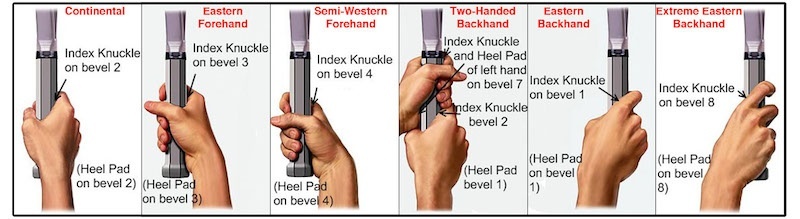
I strongly recommend the Eastern Backhand or bevel 1 for your one handed backhand grip. The forehand grip, I was taught Eastern Forehand bevel 3 but never had consistent results until I changed to a Semi-Western bevel 4 grip. Use whichever grip you feel most comfortable with and get the most consistent results from. Remember to hold the racket grip loosely until you start your forward motion of your stroke then you squeeze. After impact, relax the grip and get back to ready position.
Deciding between the one or two handed backhand grip
A one handed or two handed backhand grip should be decided on your first month of playing. One grip should feel more natural to you after playing with both. One is not really superior to the other. There are pros and cons to both grips, so I recommend trying both and sticking with the grip that feels the most comfortable and the one that you get consistent results from.
One handed backhand grip – Hold the racket on the top bevel 1 – Eastern backhand
Two handed backhand grip – For a right handed person, with the left hand hold the racket at the bevel 7. With the right hand, hold the racket at the bevel 2.
Ground Strokes:
One handed backhand: Gasquet, Warinka, Thiem all have amazing one handed backhands. What makes Thiem’s one handed backhand so effective?
Common mistakes to be aware of:
- Hitting the ball too hard. This isn’t recommended and can lead to bad habits, poor stroke mechanics, tennis elbow etc. Just hit the ball. Have a good backswing and make contact in the sweet spot and follow through, then get back to ready position.
- Trying to put too much spin on the ball. tbd
- Taking eyes off the ball. Remember to follow the ball all the way into your strings and leave it there a split second after contact. The ball is the most important thing on the court so always have your eyes on it.
- Inappropriate gripping – so as your swing is coming forward before the point of contact, squeeze, but at other times just relax when holding the racket.
- Going into the net chest first and hitting a ball as your chest is facing the net. Your left foot should lead for a forehand volley or overhead smash, or your right foot for a backhand volley if you’re right handed.
How to win a point
- Hit the ball out of the reach of your opponent
- Hit the ball with so much spin it causes your opponent to mis-hit the ball
- Hit the ball with so much pace (speed) it causes your opponent to mis-hit the ball or he can’t get to the ball
- Be super consistent to the point that your opponent makes an unforced error.
- A combination of 2 or 3 of the above.
There will always be a time when pace and power will win a point like an over head smash, but using power and pace as the main characteristic of your game is not recommended. The longer the match goes on, the more tired you’ll get and if power is your game then you’ll lose your edge. I recommend combining 1 and 4 as the main features of your game. Spin and pace will always be part of your game, but the focus should be on moving your opponent around the court, hitting the ball where they’re aren’t, and being consistent.
Daily Drill
This is the daily drill I want you to do at home and before we play while you’re at the court.
- Use a low compression ball either red or orange. The progression is to use the red low compression ball, progress to the orange, then a regular tennis ball. Adults can usually skip to the orange ball. Low compression tennis balls stay on the racket strings longer so you will have more control. They also are more difficult to hit long so they are great for beginners.
- The goal is to hit the ball 6-12″ into the air and consistently use the sweet spot or center of your strings. Do this with a Continental forehand grip on bevel 2.
- Continue for 20-30 times, then stop and re-grip with your knuckle on bevel 4 and turn your palm down and do the same drill with your for 20-30 times.
- As you advance, you will grip the racket between a forehand and backhand grip and do the exercise hitting the ball with your palm up and then palm down alternating every 10, 5, 2, 1 strokes as you progress.
- Do this every day until you feel you could do it indefinitely.
- The next step is to walk around while hitting the ball.
- The final step will be running around while doing this exercise.
 Canon M Cameras