
Tesla Model 3 20,000 Mile Review
Charging: Supercharging tips, experiences, home charging questions and answers.
I drove a 2018 Tesla Model 3 RWD long range through 31 US states from Aug 2018-Sept 2019. The Model 3 is the best car I could ever imagine since it is fast, quiet, economical, green, fun to drive, has regenerative braking, lots of rear trunk space, a front trunk, a giant screen for navigation and back up camera, free streaming music and news, handles amazingly, and performs in -10F to 110F with no problems. I recommend this car without reservation.
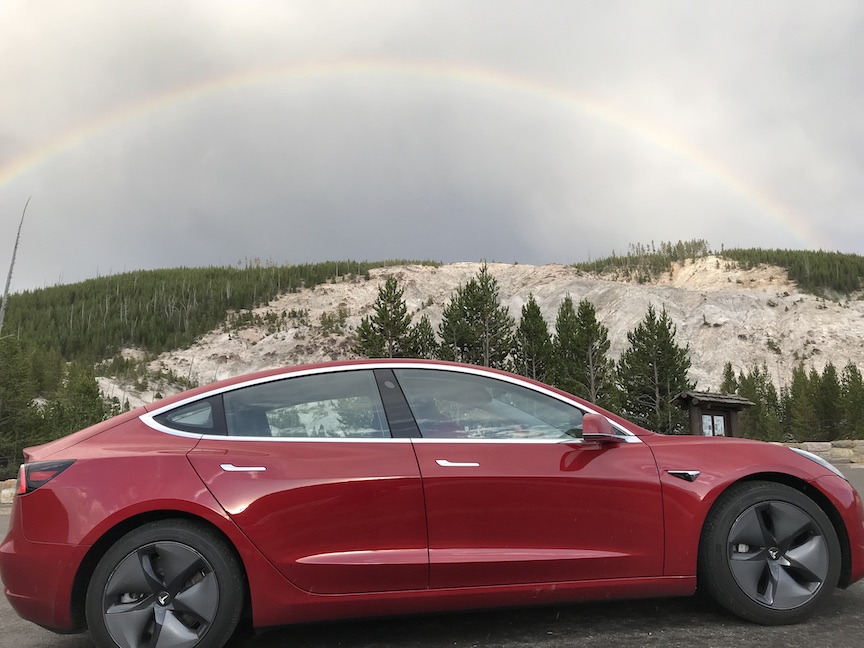
I drove 20,000 miles/32,000 km and spent $500 USD on supercharging.
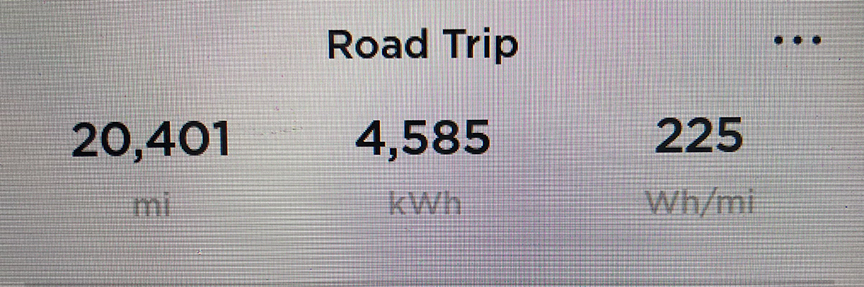
I usually charged for free at my hotel, Airbnb, or at ChargePoint charging stations. I used Superchargers when I was traveling over 100 miles on a particular leg of the trip to get from one destination to another. Once in town for a few days, I would find a local charger or charge wherever I was staying. One of the reasons I took this trip was proof of concept. I wanted to see if I could drive anywhere I wanted in this country in the same way as a gasoline powered car. One of the biggest impediments to electric vehicle (EV) adoption is charging and range anxiety, so I wanted to experience and resolve it for myself.
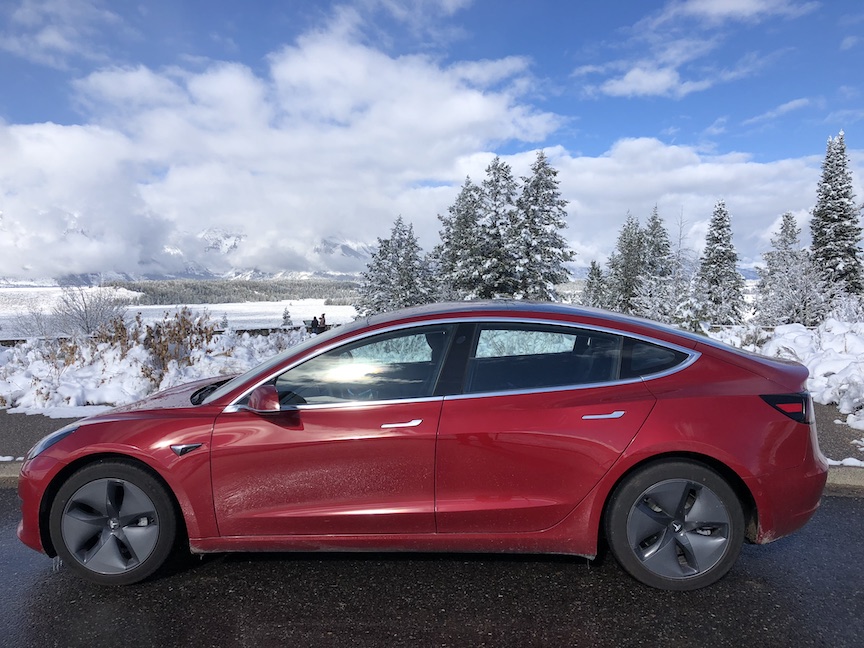
Why buy an EV?
- It’s much less expensive to maintain compared to a gasoline powered car. $50 for 20,000 miles
- It’s half the cost or less per mile for electricity compared to gasoline.
- Recharging at home! Super convenient at 15 mph of range with a 240v 30amp charger.
- No air pollution
- No noise pollution
- No worries about card skimmers at the gas pump
- No more waiting in line at Costco to fill up just to save 10 cents a gallon.
Why buy a Tesla?
- The supercharger network is the key differentiator for Tesla and all other EVs. This cross country trip was a proof of concept, that I could drive a Tesla anywhere I wanted to in the US and not worry about running out of electricity. I proved this to myself with some exceptions. I saw only 5 fast chargers that support CHAdeMO and the combo charger. Usually in a Walmart parking lot. When I went online I found a different story though. See the CHAdeMO map. Note the wrench symbol means it is a planned station and not yet operational. I’m not sure how my experience of seeing 5 of these chargers in 20,000 miles and one year of traveling isn’t consistent with this map. I went to Walmart in every town I was in for more than a few days so need to research this.
- Non Tesla EVs cannot use a Tesla supercharger so they are at a massive disadvantage. Honestly, the vast supercharger network alone would make me choose Tesla over ANY other brand EV. I expect the non Tesla charging infrastructure to catch up in 3-5 years, but Tesla will continue to build out their Supercharger network.
- Superchargers don’t have wait times. Of course I can’t promise you’ll never wait to charge, but I only saw one time when there was a wait. All other times the superchargers were 10-75% full. The vast majority were less than 50% capacity when I pulled up to charge. This will most likely change as more Teslas are sold but in 2018-2019 I didn’t have to wait one time to charge! That’s pretty amazing.
- Tesla Killers aren’t going to kill anything. I doubt they will take any significant number of sales away from Tesla. Notice how the media called the $150,900-$185,000 Porsche Taycan a “Tesla Killer” but in Sept 2019 as the car is closer to shipping and media members have actually driven one and realize it’s slower, has less range, and is $80,000 more expensive, lacks self driving technology, the media now refers to the Taycan as a “competitor” or “targeting a different market”?
Tesla Model S Perf Porsche Taycan Turbo S $105,990 $185,000 345 mile range 280 mile range 0-60 in 2.4s 0-60 in 2.6s Top speed 163 mph Top speed 161mph Cargo 30’ Cargo 15.8’ Autopilot NO AUTOPILOT The reality is it’s a vastly different market where the car costs $80,000 more and doesn’t have self driving technology. If you want to drive a Taycan long distances where you would need to charge 1-3 times in a single trip it will be difficult and will require planning ahead of time.
I’m glad that Tesla has competition though since that will push Tesla to innovate and create even more EVs. Moreover, with competition the price will come down and adoption will go up along with the installation of more chargers around the country. - Fast charger locations are often at Walmart. Yes, there is plenty of parking, bathrooms, shopping, and food available, but Superchargers tend to be at more upscale areas, outlet malls, shopping malls, restaurants. If you drive a $150k Porsche Taycan, would you rather hang out at Walmart or an upscale outlet mall?
- Fast chargers are expensive. Example: EVgo is $18/hour
- Fast chargers often have only 2-4 stalls! This means waiting in line. Superchargers have 8-40 stalls by comparison.
- Fast chargers are not uniform. They are from different companies, have different memberships, different apps, different cards to carry, different pricing. Some use a combination of CCS, CHAdeMO, or Jplug.
- Tesla can use CHAdeMO and Jplug chargers with an adaptor, the Jplug would be the most common and the adaptor is included. CHAdeMO has an adaptor, but is not worth the $450 since there will be a supercharger nearby unless you have an extreme fringe case. I expect that case to be temporary too. There is no CCS adaptor that I know of. Email Tesla if you want a supercharger in a particular location and push on local businesses to install Tesla destination chargers at 40-50 amps.
- It’s less expensive than it appears. I paid $56,500 out the door but got $7500 fed tax credit, $500 from my utility company, and $2000 from the state of California, so $10,000 in total reducing the cost to $46,500.
- It’s inexpensive to operate. I spent only $500 to go 20,000 miles. This would cost $1000-$4000 for a gasoline car. Figure charging would cost $2500 or less for 100,000 miles since I was on the road I had to supercharge, but if at home or one place for a long time free chargers are not difficult to find. To drive 100,000 miles, gas would be $5000-$12,500. That’s a $2500-$10,000 savings every 100,000 miles if you drive a Tesla.
How much would gas cost to drive 20,000 miles?mpg gallons $2.00 gal $3.00 gal $4.00 gal 20 1000 $2000 $3000 $4000 30 667 $1333 $2000 $2666 40 500 $1000 $1500 $2000 50 400 $800 $1200 $1600 Gas ranged in price from $2.00-$3.00 a gallon outside of California.
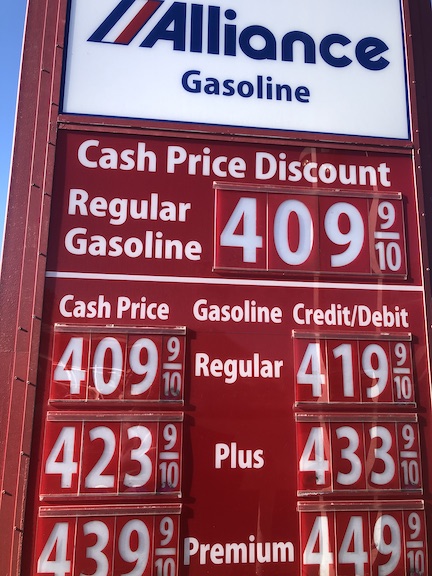
Gas prices in the SF Bay Area on 10.5.19 In California gas is $3.00-$5.00 a gallon. To go 20,000 miles, a person would need 400-1000 gallons depending on the mileage of the car. Factoring in the price per gallon and MPG, fuel cost would be $800-$5000 Looking at the table above, a Tesla is clearly the most economical car for energy cost. Even a Prius getting 50 mpg and paying $2.75/gallon will pay more than twice as much for fuel compared to a Tesla Model 3.
- Low maintenance costs. I spent $50 on tire rotation and an inspection. I had to put air in my tires twice in the last year. I have filled up the windshield wiper reservoir with 1.5 gallons of fluid. Other than that, the car has needed nothing.
- Tesla firmware upgrades are free and fast. Just connect to WiFi. New features are added, current features are enhanced, and bugs are fixed with each release. They come out every few months, about once a quarter. Know of any other manufacturer that does this?
- It’s fast, 0-60 in 5.6 seconds. Honestly, this may sound good on an ad comparing a Tesla to a Porsche, but unless you’re experienced at driving this fast from 0-60 mph accelerating this fast can be dangerous. The only time I accelerated close to the limit was during the day on empty on ramps to get up to highway speed but that’s it.
- It’s vibration free. Well, maybe not free, but difficult to notice. In a gas car accelerating from 0-60 mph in less than 7 seconds, the engine is noisy and you can feel the car shift gears and vibrate. The Tesla is super quiet and smooth, no shifting or car noise, just road and wind noise.
- The GPS screen and backup camera are massive. It’s like a large iPad. Baby boomer eyes will appreciate this.
- The LCD control panel is familiar, similar to an iPhone. The UI takes a few days to learn and then it’s second nature and you’ll wonder why aren’t all cars like this? I wonder if Tesla will adopt this UI in future cars beyond the Y?
- From -10F to 110F or -23C to 43C no significant issues or problems whatsoever. When below freezing, the door handles will freeze shut. Just smack them with the side of your fist and they’re fine. That’s the only temperature issue I encountered. If you are in below freezing temps, I’d recommend parking in the garage at night and attaching to a 120 volt plug to keep the battery on a trickle charge if you plan to drive in the morning. Turn on the seat heaters and heater 5 minutes before getting in the car and you’ll be all set.
- Sentry Mode is pretty cool and gives me security and confidence my car won’t be broken into.
- The Frunk (front trunk) is great. It is not accessible by thieves unless they pry open the frunk lid so they’ll probably break the glass and fold down the seats to get to the rear trunk instead. The frunk is a good place to store valuables. Apparently the frunk is accessible if the 12v battery is dead, not sure if the 12v battery is working if frunk can be accessed.
- The mileage indicator is really accurate regardless of temperature, AC, speed up to 80 mph, etc.
- Don’t have to worry about getting your catalytic converter stolen. Yeah, that’s a thing for gas cars and it’s getting worse. From Feb 2021 Catalytic converter thefts are surging across the Bay Area. The thieves rarely get caught – SFGate and What catalytic converters do and why Bay Area thieves are stealing them – SFGate
- Cutting edge of self driving technology. Does any other EV have the self driving tech that Tesla does?
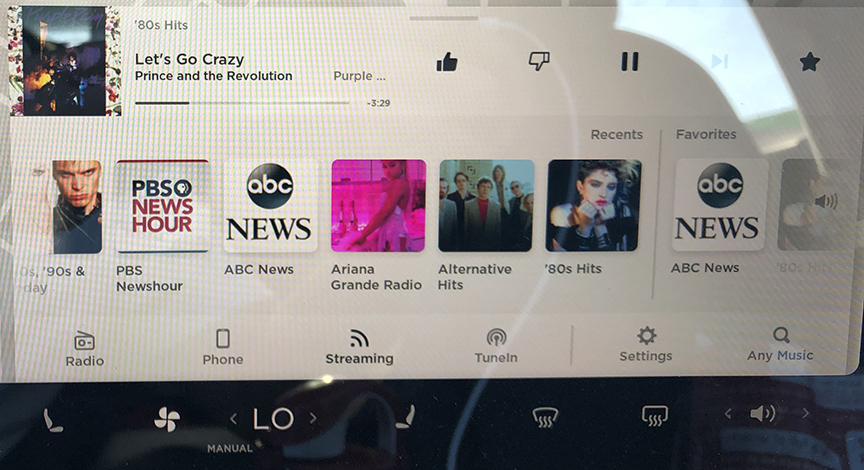
- Streaming!!! I have never heard this mentioned in any review but the free streaming is amazing! 80’s! PBS News Hour, ABC News etc! Free!!
Areas Tesla can improve
Major issues
- The navigation to the superchargers in Elko, Nevada and Jackson, Wyoming took me to the wrong area. Map it out ahead of time if you plan to charge at either of these. In Elko, NV, the GPS took me to an area about 3 blocks away from the actual supercharger which is right near Denny’s. I drove around but couldn’t find it. Tesla tech support had a 30 min wait. I went to the nearby RV park and spent the night and charged there for $25. I found the supercharger the next day when I went to eat at Denny’s. Use 2405 Mountain City Hwy, Elko, NV 89801 for the Denny’s and you’ll see the superchargers. In Jackson, Wyoming the GPS took me around the back way to the supercharger on private property. There is a fence and no way to get to the actual supercharger so I drove around the block the other side and there it was. Put the Jackson Whole Grocer and Cafe 1155 US-89, Jackson, WY 83001 in your GPS and you’ll see the chargers at the back of the parking lot. These two superchargers were the only times out of the 50+ super chargers that I visited that I had a problem with the navigation.
- Hire more tech support so wait time is 5 minutes or less.
- When I attempted to charge in an RV park in Bryce Canyon, Utah the charging failed and the error message said, “Bad cable, replace.” This error message is not accurate. The problem was what the tech in Arizona called “dirty power” which as he explained it is power that fluctuates beyond what Tesla thinks is acceptable so the car will fail to charge to protect itself. I luckily left it plugged in and an hour or so later it started to charge. The poor error message and poor technical support resulted in me staying an extra night in the hotel at $130 a night. This was my worst charging experience of the trip.
- Train the tech support techs so they provide better answers. The Bryce Canyon experience is a good example. The tech should have known that RV parks often have “dirty power” and told me to just leave it plugged in.
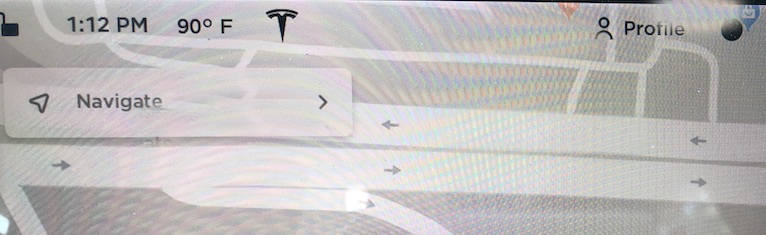
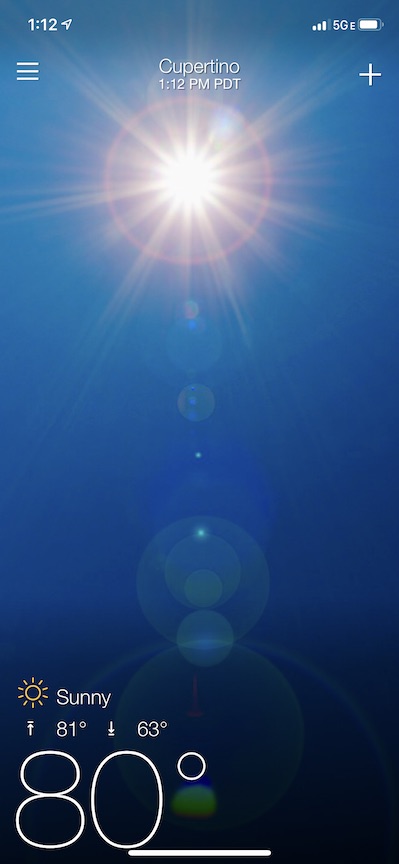 The temperature gauge is not accurate. Well, it’s not consistent with weather.yahoo.com and my guess of the temp. 90F according to Tesla, but 80F according to my guess and weather.yahoo.com.
- Idle fees – Money that Tesla charges you when your car is done charging but you don’t unplug it. $1.00 per minute after the 5 minute grace period! If there are 40 stations and you are the only one charging, you will still be charged. I really hate this. It’s not a money grab but is a kick in the ass to move your charged car so others can charge. A good idea but poorly implemented and as an end user I hate it. This is how I work around it: If you want to charge to 270, set the car to 230 and then when you get the notification that it’s almost done, increase the range to give yourself some more time. Why are idle fees a pain? When you charge it will say 50 min max, so you go to the rest room and sit down at Denny’s or wherever to eat and before you are done eating the car will be done charging so do you quickly eat the rest of your meal? Get it to go? Pay, but tell the waiter you’ll be right back, go out to your car and unplug it and then come back and finish your meal? All of these scenarios are annoying. I do think idle fees are necessary but should take into account how many plugs are free. If 9/10 plugs are free, why charge me an idle fee? No one is waiting on me.
Minor issues or feature requests
- I’d like to be able to do a screen capture of the LCD to use in this blog instead of having to take a pic.
- Time zone doesn’t update. Traveling from one time zone to another, EST to CST to MST my time zone didn’t update. Rebooting fixed it.
- The Sentry mode is not sticky. I have to set it every time I use it. I think this is fixed with the latest update.
- The Sentry mode would not record any video and not give me an error message. My usb drive just had no footage on it. Still figuring out what the problem is. I formatted it according to the directions.
- The speed limit mode was set somehow and my 4 digit pin doesn’t work. Really weird.
- The app should indicate if a supercharger is within a paid parking lot and how much it costs to park there.
- App Supercharger status – There should be a supercharger status on the app and inside the car on the LCD panel that tells the driver what stalls are not functioning, even indicating how soon other cars will be done charging if there is a wait, idle fees.
- The Navigation could have landmarks. The navigation would say I have arrived but I still didn’t see the chargers. Referencing landmarks, like “Behind Denny’s” or something would help out.
- The Tesla delivery guy didn’t tell me anything about the car. When I asked him for a business card he didn’t have one. When I asked for his name he responded with, “Why?” Anyways, he was terrible. The film on my LCD caused all kinds of problems yet he never told me about it. I figured it out months later at the Tesla dealer in Arizona.
- Eliminate free supercharging at congested superchargers. It will ease congestion at the superchargers from locals and get people to charge at home or work. There are people who can’t charge at home like apartment and condo dwellers. Not sure how to fix that problem… and if they can’t charge at work then that’s a tough problem.
- My car rebooted a couple of times within the same week or so with no warning while I was driving in 2018. This is disconcerting as the music will go silent, the GPS will stop talking, and the screen goes black. I’m pretty sure Tesla fixed this problem as it hasn’t happened again.
- In Oct 2019 before the update, I got this message that the battery was conditioning preparing for the supercharger. This was an error since I wasn’t navigating anywhere and had over 200 miles of charge left. It happened twice and then went away and I haven’t seen it since.
Drive anywhere?
Can you drive anywhere throughout the US? In general yes. I drove 20,000 miles from California to NV, UT, WY, AZ, NM, TX, LA, Miss, AL, FL, GA, SC, NC, VA, DC, DL, NJ, PA, NY, CT, RI, MA, NH, ME, NH, VT, NY, MI, IN, KY, TN, MS, LA, TX, NM, AZ, NV, back to California. I was never stranded with an empty battery. However, there were times that I had to alter my route since I didn’t have enough charge left. Bryce Canyon National Park has no Tesla or any other brand chargers. When I charged in an RV park the charging failed and the error message said, “Bad cable, replace.” I called Tesla to send me a new one but they replied it would take up to a week. They said they could tow me to the nearest Tesla dealer 400 miles aways. All poor options. I left my car plugged in and after a couple hours it started charging and I had a full battery after 10 hours. As it turned out, the error message was wrong. The problem as the Tesla service guy explained it to me was that RV parks have dirty power, power that fluctuates up and down and the Tesla charging system recognizes it and won’t charge the car. The car will keep checking and when the power smoothes out, charging will start. Glacier National Park also has no nearby chargers. I rented a gas car and did this park on another trip in 2018. In Maine near Acadia National Park there are no Superchargers and the chargers I found on the Chargepoint app were either not working or were occupied. I ended up driving all the way back to Brewer, ME about 40 miles one way just to supercharge. This was poor planning on my part, but still a situation you can get into without careful planning. So to summarize, in general you can just go drive anywhere, but if going on a long road trip I would make sure that you charge up before going to an area that doesn’t have any superchargers like Acadia National Park or Glacier National park and have a charging plan. This of course can be eliminated with just one supercharger station inside the park. The town closest to Dinosaur National Park is Vernal, Utah but they don’t have a Supercharger either. Dinosaur Inn has a Chargepoint charger. I recall the cost was $1.00/hour and I got 20-30 mph of charge from it.
Range
Besides just comparing the range of one EV to another, it’s important to note that you won’t run your range down to 0 before charging, nor will you charge it to the maximum possible. Charging the battery to 100% reduces its life and regenerative braking doesn’t work at that charge level. A good rule is 10% from the bottom and off the top so a 300 mile range is effectively 240 since you charge to a maximum of 270 miles or less and recharge at 30 miles or more. This is fine for cars that have a stated range of 300 miles, but for anything less, you can see how this guideline really impacts them. If you compare this to a gasoline car it may come up short, but in reality, going 80 mph for 3 hours or more you’ll want to take a break to stretch and use the restroom.
Range Anxiety
Defined as: Getting overly worried that you’ll run out of charge and get stuck in the middle of nowhere in the middle of the night. It’s normal but also easy to treat and address. I had a slight case of Range Anxiety but overcame it on this trip.
At a policy level, the Fed Government should step in and mandate every gas station have at least one level 2 charger and one Fast Charger. Then give incentives to install additional chargers. Imagine if EVERY gas station throughout the US had level 2 and fast chargers? That would squash Range Anxiety overnight. This will probably never happen so at an individual level:
- Plan out your trip with Go Anywhere so that you can rest assured you won’t run out of juice. Note that there are chargers available that don’t appear in this app, so use Chargepoint and just do a google search. All three methods are required. If you just rely on your navigation, you will miss a lot of charging spots. Plugshare looks like another good webpage, but I didn’t use it on this trip
- Install the chargepoint app. On the freeways you’ll use superchargers but once in town, look for the Chargepoint chargers since they are usually free! They send you a card in 1-2 weeks after signing up online. You need to carry the card with you since there are chargers in garages that have no WiFi or cell service and you won’t be able to get the charger to activate if you only rely on the smartphone app.
- Bring your Jplug SAE J1772 Charging Adapters. It is absolutely required. I used mine almost every time I charged excluding a Supercharger. They are $95 but one was included in my charging kit.
- Charging at your Airbnb. Initially I made a point to select only Airbnbs that allowed me to charge my car. It seems like a great convenience. However, people would say there was a plug I could use and then it was 30-40′ away from where I was parking. Others wanted to charge me $10 or more to charge figuring it was similar to a tank of gas.
- If you are charging and something else of high amperage is on the same line and comes on, you may trip the circuit breaker so if your app says charging stopped, that is probably the cause.
Questions strangers always asked and my answers
- What’s the range? 300 miles is my standard answer but it’s really not in practice since 10% on the bottom and top would be 240 miles before having to charge again.
- How long does it take to charge? Charging at home on my 240v 30 amp dryer plug I get 23 mph of charge on 237 volts at 24 amps. On a standard 120v outlet I get about 4 miles per hour of charge. On a supercharger, I get 100-600 miles per hour of charge. This always shocks them. The MPH takes a while for them to understand that I’m referring to charge and not driving. Maybe RPH Range Per Hour is a better term?
- Any problems? Nope.
- How much is maintenance? In 20,000 miles I rotated the tires once, put air in the tires twice, and added 1.5 gallons of windshield wiper fluid. That’s it.
- Is it difficult to find places to charge? Nope. Tesla has a vast network of superchargers and the navigation shows you where you have to stop and how long you need to stay there before continuing on your trip. It’s really amazing. There are also public chargers all over the country and most are free.
- Does it drive around by itself? Not yet, but they are working on it.
- Do you recommend buying one? Yeah, I highly recommend buying one since you’ll never need to buy gas again. I only paid $500 to go 20,000 miles so it’s 1/2-1/8 the cost of a gas car just for the fuel.
At some point, I felt liked I worked in Sales for Tesla but wasn’t getting paid. People anywhere outside of California or a major city have not really seen a Tesla before. They are a rare sight. Strangers also feel they can monopolize your time while they ask you all these questions. “Excuse me but I have to go to the bathroom,” I found is the best excuse to just walk away from them. I considered printing up a card with all the questions and answers above to just hand to people. I might do that before my next trip.
Misc
- 80 mph is a good speed limit. A note will pop up to “Keep it under 80 if you want to reach your destination.” which oddly has much more influence over my speed than the fear of getting a ticket for speeding.
- Hot Weather. 90F-110F Not a big deal but I wish I could lock the seat heaters off since there were a few times I accidentally turned them on. Seat coolers/fans would be a welcome upgrade. I’d pay extra for it. Sometimes the AC seems to drift and get warmer and then get cooler even after being on for a while. At highway speeds the AC seems to get colder. Other than that, performance in hot weather is without any flaws. Amazing.
- Cold weather. In below freezing weather, the door handles will freeze shut. Just smack them with the side of your fist and the ice will break up and the handles will free up. The battery will say warming up or something. There is absolutely no hesitation or anything else you’ll notice car wise except for cold seats and a cold steering wheel. I’d turn on the seat heaters remotely if I could. A steering wheel heater if it was an option I would probably opt in if $100-$200. The car runs perfectly in -10F as it does at 70F temps. Amazing.
- The OS upgrades over WiFi are super convenient and a model EVERY car manufacturer should follow for ALL of their cars. What if a recall could be fixed with an update over WiFi or 3G? So much more efficient.
- The overall UI of the iPad like display screen interface is amazing. I’d recommend Tesla consider doing this for all future models to simplify design, maintenance, and support.
- The GPS is amazing. The large display and zoomable iPad like touch screen interface is absolutely a game changer for people with over 50 year old eyes.
- The backup camera image size is absolutely amazing.
- Sentry Mode – A great idea. It will record video of anyone getting too close to your car and even play the stereo really loud to scare them away. Keep in mind you’ll lose 10-20 miles of range over night depending on how many “events” you get throughout the night. My USB did not have any video on it, so I have to investigate.
- The glass roof looks great but if I were to buy again and there was an option to save $200 or more on having a solid roof and not the glass one I would opt in in a heartbeat. I have the shade on it and have never removed it or looked up through it. Okay, once when I slept in my car I looked up at the stars but that is the only time. I don’t plan to sleep in my car much.
- Buy all four 220v charging adaptors. I have used all of them on this trip. Have the 50 amp and two 30 amp adaptors so you can charge up in garage dryer plugs, and RV parks. I ran into another the NEMA 6-50 used by welders and electric ovens so I couldn’t charge since I didn’t have that adaptor. This one you can skip though, only needed one time. Adaptors are only $35 and can get you out of a tough situation. There is a 2-3 week delivery time so order before you leave on your trip.
- RV park voltage fluctuates and the charger will refuse to charge, but if you leave it plugged in, it will start to charge when the voltage evens out and oddly will continue to charge. I suppose I got lucky but it didn’t seem like it.
- Use the Sentry Mode since you never know what area you might travel to and park your car. However, it draws juice, like 10-20 miles a day, maybe more so be aware of that.
- Install the charge point app and make sure it works. It takes weeks to get the card so plan ahead.
- Some garages have no WiFi or cellular reception so it’s a good idea to have a Chargepoint card since the app won’t be able to connect to their network. I only used Chargepoint brand of chargers besides the Tesla superchargers. I haven’t found a need to use any of the other brands. I don’t really see them around. There was one charging station in a Walmart in El Paso, Texas that had the fast chargers but Model 3 doesn’t have those CHAdeMO adaptors as of yet.
- For some reason the Sentry Mode is not sticky so you have to reset it to On every time you use it. Annoying. It takes up energy since I noticed my mileage decreasing while it was engaged. Like 10-20 miles throughout the night. This is significant so keep that in mind.
- Only problems I’ve had is back up camera doesn’t immediately show the back view.
- The passenger side mirror did not retract twice when the car was turned on. I’ve also had my car reboot spontaneously for no particular reason. A bit unsettling and I lose my GPS since the screen goes black, but it comes back on after a minute or less. Other than that, the car has been perfect.
- GPS will be off by 1-4 blocks when taking you to a supercharger. Don’t panic. Just drive around for a few blocks and if you can’t find it ask someone at a store since they’ll probably know.
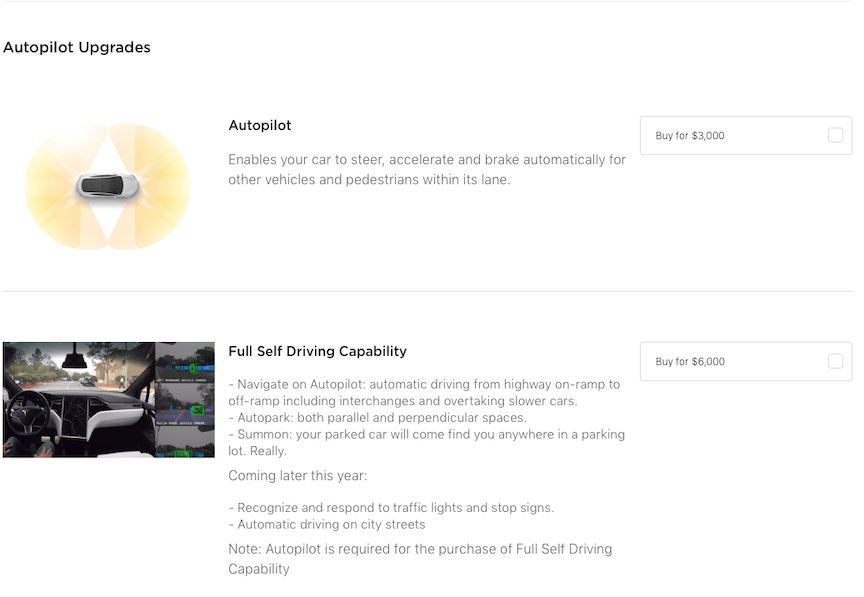
- Autopilot is $3000. It’s high end adaptive cruise control that keeps you in your lane. Once you set the upper speed limit, it will accelerate and decelerate and brake as required. Full Self Driving Capability is an additional $6000. The goal is what you would expect, typing in an address into your navigation and the car goes there without any more driver input. I didn’t get either since I figured I could just pay for them when they are finished, otherwise it feels like paying for beta software. I got a 14 day trail the day I started on my trip. I was impressed but didn’t really test any of the features out besides the adaptive cruise control.
- Off Roading – So off roading is obviously not something to do with a RWD M3. However, I did drive slowly on good quality dirt roads. Specifically from Highway 191 down Schwabachers Landing Road in The Grand Tetons National Park.
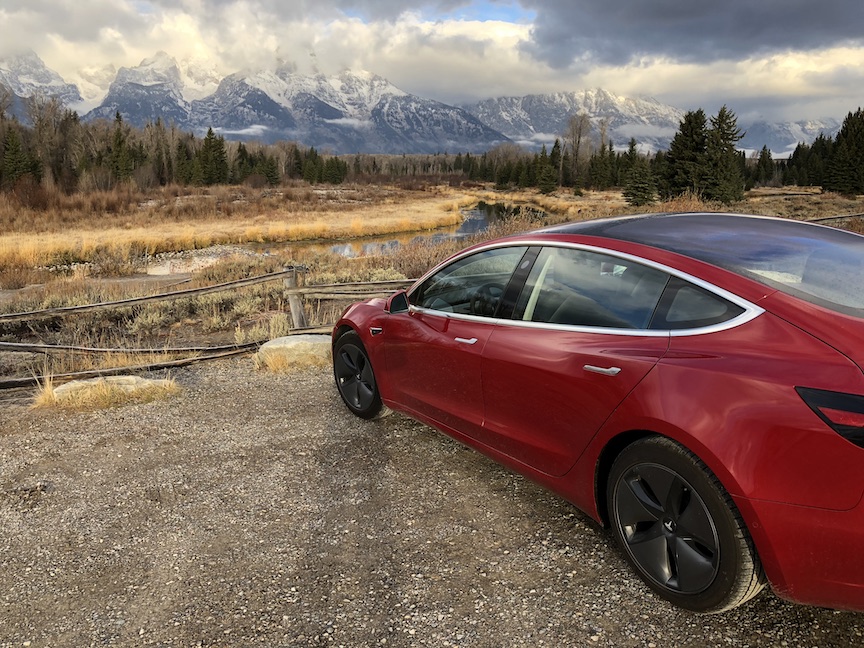
I also drove it on Hohokam Road to Golden Gate Road in Saguaro National Park. Drive slowly and look for potholes and anything that might damage the tires. AWD isn’t really as much of an issue as ground clearance and suspension. There were several roads on this trip that I avoided due to ground clearance and the worry of getting stuck or damaging the car. The AWD dual motor is really for ice and snow. - Deep Snow – I have the RWD model since the AWD model was not available in June 2018. Having a RWD car is the least desirable drivetrain when on snow or icy roads. However, it was never an issue. Why? The roads are always plowed in Jackson, Wyoming and everywhere else I went. Cities with tourists depend on their infrastructure for commerce so they plow the roads constantly during the snow season. The deepest snow I drove through was 3-5″ with ice underneath but I was fine driving slowly and not steering or braking abruptly.
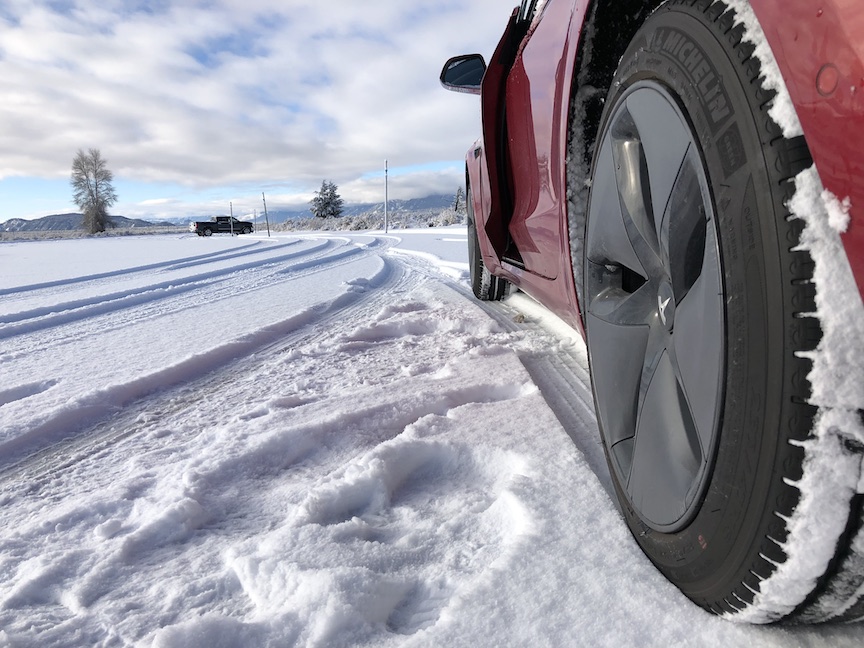
The roads were icy especially first thing in the morning, but this was never a problem. I bought the Tesla chains but never used them. Difficult to see below but this road was totally iced over. Difficult to walk on but driving slow was fine.
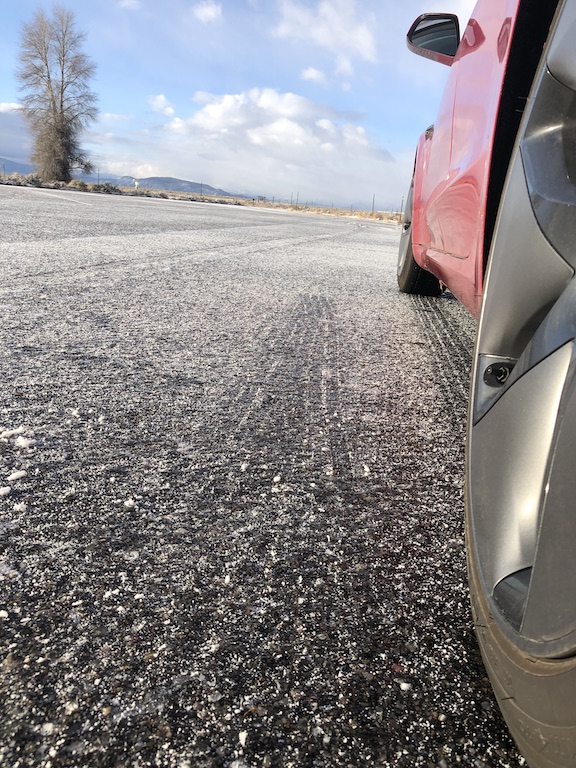
Notice the ice above? On flat roads it’s no problem but on a hill I experienced some slippage. AWD would come in handy in these situations, but the key is to drive slowly and do not brake or steer abruptly. The regenerative braking was the key. This slows the car down without braking so you won’t risk skidding. I never experienced deep snow. Most of the cars are Subarus or the Ford F150 here in Jackson, WY and other states so they are ready for the snow. If in a snow state or area I would get the dual motor model. I’d also trickle charge the car on a 120V system so it will be ready to drive in the morning. I think the battery has to warm up or something so this trickle charging should help keep the battery warm.
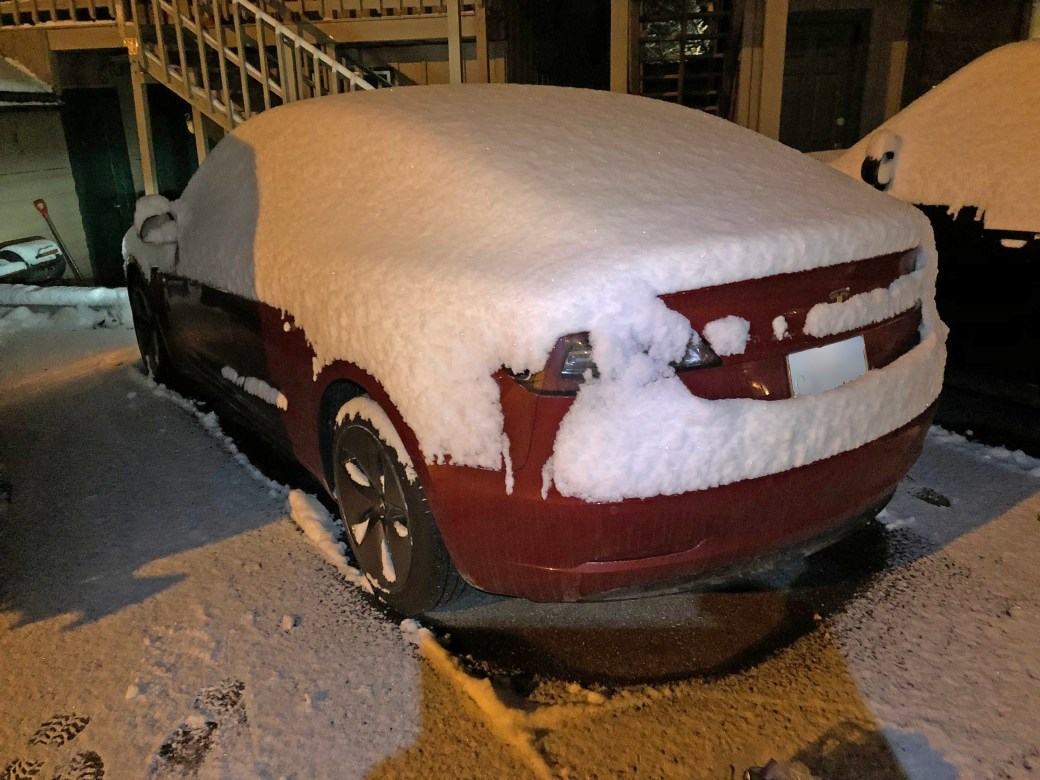
The mornings were tough since temps were below 0F to 10F (-17C to -12C) and it took about 15-25 minutes to thoroughly de snow the car. I used this $10 snow brush from Amazon but this Snow Moover brush looks even better.
A word about media coverage omissions:
Media coverage of EVs focus on the EVs themselves and ignore the charging infrastructure that we all don’t give a second thought to filling up at gas stations our whole lives. The charging infrastructure should be a major part of every EV discussion. I drove 20,000 miles from California to NV, UT, WY, AZ, NM, TX, LA, Miss, AL, FL, GA, SC, NC, VA, DC, DL, NJ, PA, NY, CT, RI, MA, NH, ME, NH, VT, NY, MI, IN, KY, TN, MS, LA, TX, NM, AZ, NV, back to California. With no charging plan I wanted to see if I could just drive around the country like a gasoline car not worrying about finding refueling. I ran into 1 problem in Bryce Canyon, Utah but that was it. It will be years before a non Tesla charging infrastructure is developed. This is fine if you mainly drive from work to home and back and occasionally go within 500 miles of your home, but for anything longer, a comprehensive fast charging infrastructure is required. Tesla is 80-90% there. Everyone else, I’d guess about 10-25%. I saw 5 fast chargers in 20,000 miles of driving and always at Walmarts. Tesla superchargers can even have their own private lounge with WiFi, restrooms, AC, and nice leather chairs. See the Kettleman City, CA supercharger location. Another key point? As the fast charger network gets built out this benefits Tesla owners too since they can use them with an adaptor, but a non Tesla car owner can’t use the Tesla supercharger network.
The range war is really over. Tesla won. Others will catch up, but where are they going to charge? The fast charging infrastructure race is over. Tesla won. Others will catch up, but Tesla will be ahead for many years.
In conclusion, I highly recommend getting a Tesla, especially a Model 3. The price, low maintenance, low recharging costs, reliability, user interface, performance, styling, self driving technology, and supercharger infrastructure all make it the best EV available today.
Which tesla?
So this blog has been about the Model 3. Rough base prices with full self driving are S: $83,000, 3: $56,000, X: $88,000, and Y: $58,000. I have driven the S, 3, X, and Y. Here’s my take: The S is great, but a really big car with a long wheelbase. It costs $30k more and unless you need a big car, I’d opt for the 3. The X feels clunky, heavier, and slower than the 3. At $30k more than a 3 and Y, and I’d opt for either of those before an X. The Y is great, but the ride is stiffer than a 3 so unless you want the SUV type of body, higher driving position, and more space, the 3 will be a smoother ride. I’m looking into softening up the Y’s ride for a friend by getting 17″ or 18″ wheels and higher profile tires to keep the same overall diameter. The stock rims are 19″ so I’m hoping this will be a quick fix to softening up the ride.
October 2020 update
So it’s been a year since the first draft of this was published and over 2 years since I bought my Model 3. Due to the pandemic I’m only driving it once every 2-3 weeks to get groceries. Current mileage is 27,000 so in the last year I’ve only put 7000 miles on it and expect Oct 2020-Oct 2021 to drive maybe half of that. There has been no additional maintenance costs. I charge at home for free. This car and all Teslas save the owner so much money compared to an ICE car.
Full Self Driving – So I recommend getting it if you purchase a new one, but I don’t currently have it. I figured I can always get it later especially if I go on another road trip. I was driving my friends Model Y on 101 near Gilroy when the car braked hard and steered to the left. My head was about 6″ from the steering wheel it braked so hard. I’m like WTF just happened? My friend said a car on the right lane behind my peripheral vision swerved into our lane and would have hit us if not for the self driving accident avoidance kicking in. Wow. So yeah, I guess spend the extra $10,000 and get the Full Self Driving package.
MARCH 2021 Update
Three more months and it will be three years since I got my Model 3! Time flies. Not much to report, no new maintenance required so $50 is all I’ve spent on it in three years. I don’t drive much at all since the pandemic started a year ago.
So, I guess I told you so… What’s Missing in the Electric-Vehicle Revolution: Enough Places to Plug In from the WSJ. This will change, I’m sure, but it will take time. If you plan on taking road trips, Tesla is the only smart choice until the non Tesla charging grid catches up. Give it a few years.
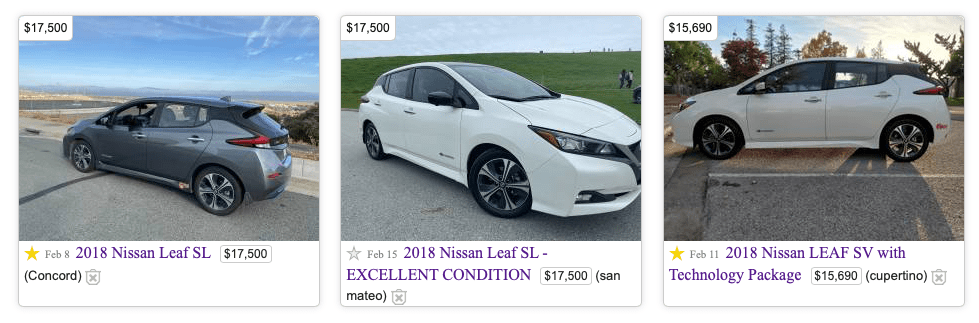
Something else that puzzles me, other EVs like the Nissan Leaf have a very, very steep depreciation curve. The Leaf was redesigned for the 2018 model year. Doing a search on cl there are three cars that fit Nissan Leaf SL 2018-2021. They have 33,000-43,000 miles but are less than half the price of a new one in only 3 years. Is it battery degradation? New their range was 151 miles. The new S Plus has a range of 226 miles but costs over $38,000 so might as well get a Model 3. There are 59 model 3’s on cl from $33-$59k. That’s a large market. Only 1 Model Y.
May 2021 update
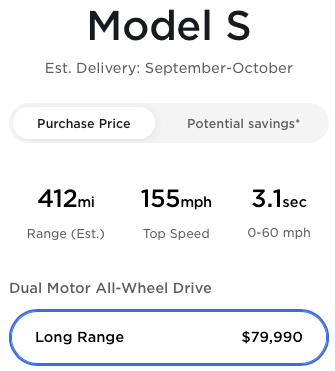
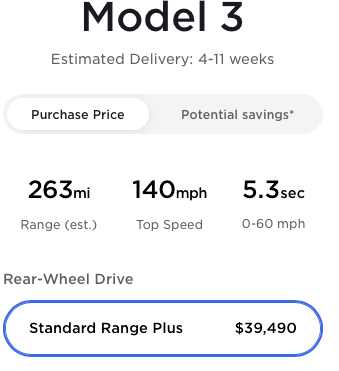
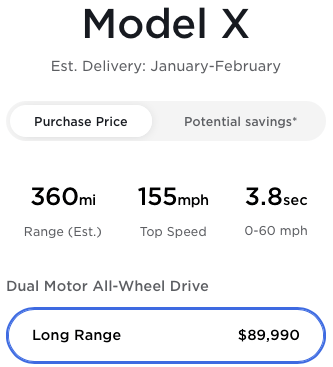
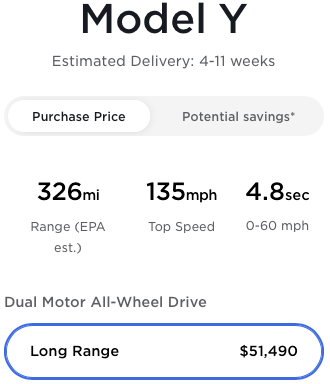
One thing that would worry me if I was a stockholder is that delivery dates are months out. As of May 16, 2021: S: Sept-Oct 2021, 3: June-August, X: Jan-Feb 2022, Y:June-August
June 2021 update
Three years since I’ve had the car! Time flies! In those three years there have been many more Superchargers installed. Ford has released their Mustang E that’s been getting good reviews and is selling well. Porsche released the Taycan for $80,000-$187,000. Not sure if they are selling well or not. I haven’t seen one driving around ever. The Y was introduced in March 2020 and is selling well. There are always 20-30 used Model 3’s on CL at any given time. I guess maybe leases expired or people just want to upgrade to an AWD Y or X or S? I dunno. The car is perfect except I wish I could get a factory installed hitch. I’m waiting to get a third party hitch installed until my warranty runs out since the hitch will void my warranty. Other than that, not much EV news in the last 3 years!
AUGUST 2021 update
The odometer will roll over 30,000 miles (49,000 KM) this month. No new maintenance costs, so only $50 to go 30,000 miles. An ICE car would be much more. A Lexus would be $300/10k, $300/20k, $600/30k so $1200 total. My tires are down to 2/32’s-3/32’s so time to replace them. I’m probably going to buy Michelin Cross Climate 2 tires since I’ve heard good things about them. No complaints with the OEM tires though. The sales guy at America’s Tire said most Model 3 owners only get 12,000-20,000 miles out of the OEM tires, so getting 30,000 I guess is pretty good. My miles were almost all highway so I assume that’s easier on tires? I dunno. There have been improvements in the last three years to the 3. They are AWD, cheaper, have Auto Pilot included but FSD is still another $10,000. The FSD cameras I think have been updated somehow too. The Y is a great car, but the handling is a little on the stiff side for me, the 3 is a much smoother ride. It also has a lower center of gravity so it handles better. Ideally I’d like to get a truck like the Ford Maverick but the EV version which does not exist yet.
After 3 years there is still no viable competitor to the Tesla 3. Ford came out with their Mustang but it doesn’t have full self driving capability hardware or software built in as far as I can tell. No charging network. Worse, there is a 16-28 week wait for the car! I have seen a few driving around, but waiting so many months after ordering will definitely put a dent in sales figures.
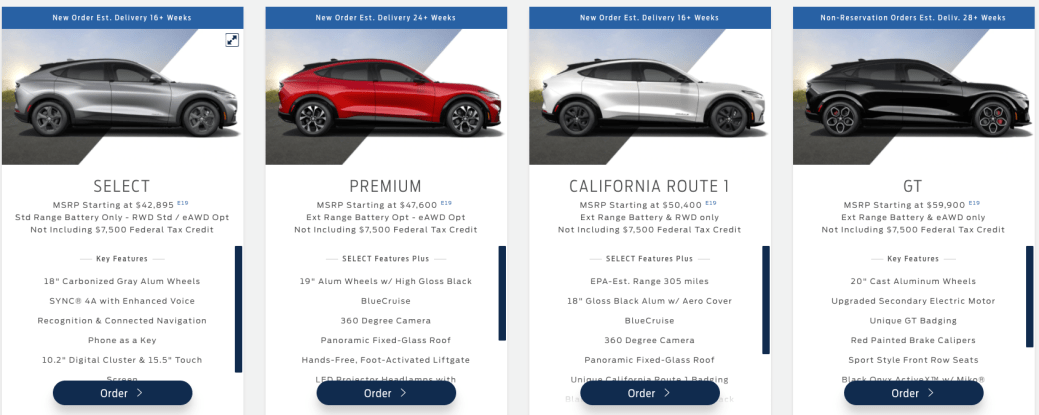
The Lightning F150 I’m sure will be a winner. I’m just hoping the Maverick gets an EV version. In the next 3 years I’m sure there will be many more EVs available for sale, but in 2021, from this list, I’d recommend a Tesla for all the reasons above, or the Ford Mustang Mach E if you can be happy with no FSD.
Charging at home at 15 mph is one of the most convenient features of an EV. It’s also the major reason why owners of EV go back to an ICE car since they don’t have a garage or access to onsite charging. If you have a garage, get a 30-50 amp charger installed and you will realize the full benefit of owning an EV.
I changed my utility bill to charge different rates for time of use. The cheapest is from 00:00-15:00 at 0.15c a kWh.
My friend charged her Tesla on a weekend between 15:00-18:00 and paid about $10 for 100 miles of juice. I remember on my road trip I paid about $10 to go 300 miles so prices fluctuate based on time you charge and what supercharger you use. Not sure what the average price is but a good thing to know before you fill up.
september 2021 update
So I saw the Porsche Taycan in a parking lot in Costa Mesa, Ca and it looks pretty good. The price range is $83,000-$150,000. The car looks pretty low to the ground so getting in and out would be challenging. The range is 200-230 miles and without a comprehensive charging network, a cross country trip would be difficult and frustrating. However, if you only go 500-600 miles on a trip one way, and you have fast chargers along the route it might work. Finding functioning fast chargers will be another issue so you’ll have to plan out your trip beforehand. Still, for the people who don’t want to buy a Tesla for whatever reason, the short range Taycan can work if you can tolerate chargers that don’t work. The interior is a bit old school and not thought out like a Model 3 or Y. Ordering one includes numerous expensive options to choose from. I prefer Tesla’s simple ordering process.
The video above is an interesting test that gives the viewer a real world user experience comparison between three cars. I disagree on two points: 1) The range on the Tesla being a best case scenario, almost an overselling. I found on my road trip the estimated miles you’ll get was dead on accurate. Even in the video they ran the battery all the way down to 1 mile before recharging! I don’t recommend doing that, but it really contradicts his own position that the estimated range isn’t accurate. 2) The problems with Electrify America chargers being offline and the app not letting the user know is really a deal breaker. This situation is extremely inconvenient and a deal breaker and not just some minor annoyance. Imagine being a woman traveling alone at night when you pull up to a charger with only 10 miles left in your battery and none of the chargers work. Moreover, you don’t know until you try them and the app didn’t inform you of their status. You just wasted how much time? Now you’ll have to drive to the next nearest charger and what if it’s beyond the range you have left in your battery? or what if those chargers are broken too? If you plan on taking road trips, the state of fast chargers infrastructure would be enough for me to only consider a Tesla for a road trip.
So in 2018-2019 when I charged at a supercharger and one charger was so much slower than another, I’m sure it was a 150kw charger versus a 250kw charger. Now I noticed the chargers are marked as such. I suppose Tesla mixed the chargers to balance the electrical load? I suppose if you’re going shopping you may want to charge on the slower charger so you don’t have to worry about idle fees so much.
Also, though I estimated about $10 for 300 miles in 2018-2019, the cost in 2021 is roughly $10 for 100 miles. Different superchargers have different rates. The rates also depend on what time of day you charge so your LCD screen should tell you how much a charger is per kWh just tap on it.
The new Model 3 has a different center console, AWD, auto pilot is standard, and the trunk lid is powered like an SUV now. All good improvements but not worth selling mine and buying a new one.
I had a Tesla tech come out and set me up with 2 new keycards. You can actually just program the cards yourself if you have a card that works. Just have Tesla send them to you. He also did some free maintenance, replaced my charging pins and did something with the frunk latch. He also aired up my tires. He noticed I was missing a magnet on my charging port lid so he came back out a few days later and replaced that. I only had to pay $15 each for the key cards. I’m also going to replace my cabin air filters. I bought a pair of Spearhead Premium Breathe Easy Cabin Filters on Amazon for $20. You need 2 filters. I will also check my brake fluid to see if there is any water contamination with some brake fluid test strips. This is the only maintenance the car has needed in over 3 years and 30,000 miles!


Sept 12, 2021 update
So I went to the Ford and Porsche dealers to look at the Mustang Mach E and Taycan this past weekend.
Mustang Mach E. I drove a Mustang Mach E premium around the block a few times. Here are my first impressions:
- Not as fast as a 3 or a Y but plenty fast enough
- The screen in back of the steering wheel is fine.
- The vertical screen in the middle of the dash is fine with the large dial at the bottom.
- The UI of the vertical screen is adequate, but not great. Getting back into a Tesla I noticed the resolution on the Tesla LCD is so much higher and the UI is so much better.
- Makes a clunk noise like the car is dropping into gear whenever I accelerated from a complete stop. This needs to get fixed asap.
- Feels and handles like an SUV.
- Apparently they are in short supply with 4-6 month waits on one you order online.
- Looks are of course subjective but I think it looks pretty good.
- I’d consider buying one even without the FSD if it’s priced right and I get the Federal Tax Credit and the clunk is fixed.
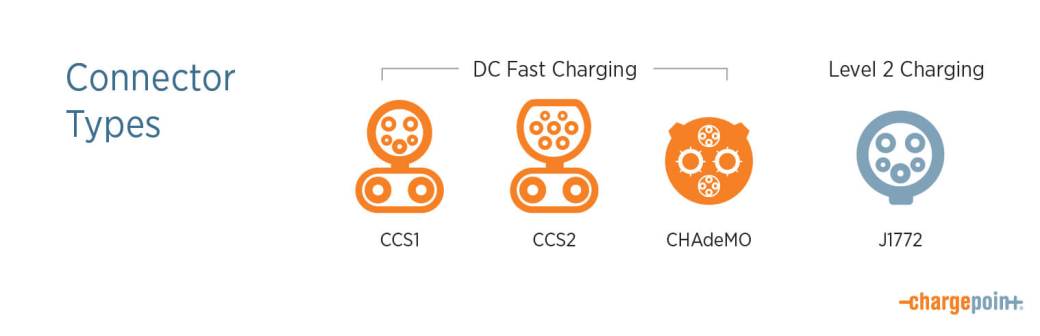
- Charge port is a CCS type 1. After my test drive I was sitting in the salesman’s office and I realized I hadn’t looked at the charge port so I asked him which type it was. He replied, “The round one.” I am not making that up… so I went back outside and took a look and it’s a CCS1


Taycan. Though I didn’t drive it since the dealer had just got the car the day before and it wasn’t prepped or detailed here are my first impressions:
- Odd name, not sure what it means or how to pronounce correctly. Tay Kin? Tie Can? but this is similar to the Macan, Cayman, Cayenne, or Panamera. Maybe they should have stayed with numbers?
- The car is low, much lower than a Model 3 and was not easy to get in and out of. You feel lower sitting in it too. The rear window visibility was poor, really poor. Not sure if the backup camera can be used instead?
- Steering wheel was not leather but suede, didn’t appeal to me at all, but leather is definitely available.
- Clearly this car was designed by an ICE car designer since the interior has screens everywhere, even for the passenger which I thought was really odd and not worth the extra $1100 that the dealer charges for it. Looking at the website, options are more numerous and expensive than you can imagine. This really made me appreciate Tesla’s no dealer or dealer markup model. Just order online and pick up at a delivery center or dealer. Sales people don’t get a commission from what I understand.
- The trunk space with the seats up or down is significantly smaller than a Model 3. The car has a frunk too.
- The car can also make noise when you accelerate mimicking the sound of an ice car. Kind of goofy, but not sure if the exterior produces sound so pedestrians can hear you coming, especially important for sight impaired people. Can definitely hear it in the interior.
- Looks way cool. Styling is somewhat similar to the Panamera but superior. Styling and scarcity of Taycans on the road also increases the interest and coolness. A Model 3 or Model S are everywhere here in the Bay Area but rarely do I see a Taycan on the road.
- Too expensive. With basic options this car costs much more than a Model S and does not have full self driving capability and a much shorter range than a Model S. Not worth the money.
- Stated range of 220-250 is apparently a lowball estimate with owners and testers getting around 300 miles in real world driving. Not sure why the stated range is so far off but this is verified by a few online sources so research before letting the range dissuade you from buying.
- Ordering a Taycan online, you’ll have to wait 6 months to actually receive one. This of course destroys sales numbers, but Tesla and Ford have similar wait times.
- The charge port. I didn’t take a pic of it, but apparently it has two charge ports, one on each side of the car. For level 3 charging, one plug is a CCS combo type 1, common in the US and the other is a CCS combo type 2, common in Europe so that way they can ship the car to any country and it should be good to go charging wise. For level 2 charging, you should be able to use the Jplug section of the CCS1 port. CHAdeMO is probably going to be extinct except in Japan.
 However,
 - Porsche doesn’t own charging infrastructure so that means Taycan owners are reliant on a third party like Electrify America which has its issues with too few charging stations, chargers only charging up to 50kw, 67.5kw, or 150kw, but not 250kw like the fastest Tesla Superchargers, a non functioning charger’s status isn’t visible on the app, an in use charger’s status also is not visible on the app etc. so this needs to get fixed asap.
- According to insideevs.com the Taycan uses over 400 Wh per mile! My Model 3 uses about 225 Wh/mile.
If you don’t plan on taking road trips and don’t want a Tesla Model S or Model 3, the Taycan is an alternative, though a very expensive $100,000-$200,000 and inefficient alternative.
August 6, 2022 update
I’ve got 40,000 miles on my car now! No real news. I will have to change the brake fluid this year most likely but other than that the car is pretty much perfect. I’ve ridden in a newer model and the auto trunk lifters are a definite plus, but the noise the car makes at low speed and backing up I can do without. I know it’s a safety feature but whatever, it’s a bit annoying. The supply chain is still a mess. My friend put in an order on his Model Y back in Jan 2022 and he still hasn’t gotten his car yet in Aug 2022. There are more EVs now, Kia, Audi, Nissan, BMW has a 4 and X series EV but I never see them or hear much about them. Why market what you can’t get in stock right? Used prices are still high and Tesla seems to raise their prices a little bit each quarter. Ford had a massive recall on their Mustang Mach E so read up on that before buying.
August 25, 2022 update
Big news, by 2035, new gasoline and diesel cars will no longer be sold in the US, Europe, and Canada. China will ban the sale of new gas cars by 2030! So the next 13 years should see a lot of new models being introduced. California is poised to phase out sales of new gas-powered cars. I imagine some gas cars will become classics and rise in value. What will happen to gas stations? There will be some left, but I’m sure many will close. It might be an easy assumption that charging stations will take their place but I don’t think so. Look at where Tesla superchargers are placed. I expect a similar placement of future charging stations. The wait to buy a new EV is 6-18 months so obviously this needs to get fixed before new gas car sales are phased out. The 2022 Inflation Reduction Act has a new EV tax credit but it is really complicated, read the article by electric.co to figure it out. Used gasoline car sales will still take place like they do now.
The fact that Toyota, Honda, and Nissan are so far behind in developing EVs is a mystery to me. They went all in on hybrids, at least Toyota did but ignoring EVs just seems in conceivable, yet here we are in 2022 and no EV available from Toyota or Honda and just the old Leaf from Nissan. Honda says they will launch 30 EVs by 2030, but seriously, they don’t even have one available today so I find that difficult to believe. The big 3 had all the production and design know how and some how totally miss the boat and even screw up as bad as this: Toyota is offering to buy back an electric SUV because its wheels could fall off – CNN I honestly wouldn’t believe this was happening except I verified it with other sources like Autoweek and Car and Driver. Very hard to believe, but yeah, it’s real.
September 27, 2022
I have 42,503 miles on my car as of today. I bought the car in June 2018, put 20,000 miles on it that first year and then drove it less than 10,000 mile per year after that. My friend ordered a Model Y in Jan 2022 and finally got it in Sept 2022 after several delays. Figure a 9-12 month wait due to the supply chain. However, a guy I play Pickleball with ordered his Y on a Friday in Dec 2022 and got it the following Monday! So your experience will vary. Anyways, here are some questions my friend had:
Q: Should I use the Tesla Superchargers?
A: I read that it is better for the battery to charge at a lower amp and voltage charger like a 120v 20 amp to 240v 50 amp instead of a Supercharger. Supposedly the battery will last longer, so I only use a Tesla Supercharger when I’m on a road trip. Ideally you charge at home. Change your PG&E bill so you get charged different rates at different times, then charge whenever it’s cheapest, usually 00:00-15:00 or midnight until 3:00pm the next day, but it depends on the city you’re in. If you do charge at a supercharger, look on the app to see how much it is per kWh since different locations charge different rates, and the rates change depending on what time of day you are charging. Peak times are usually 15:00-21:00 or 3:00-9:00pm. Note that your city may have subsidized (free) charging at a school etc so please look into this.
Q: Any items from Tesla that you purchase through them like a windshield shade or floor mats?
A: The floor mats I got from tesmanian and have been happy with them. The sunroof shade I bought from Tesla, but there are probably third parties that sell them now.
Q: How about Tesla’s repair tire kit?
A: I didn’t buy this. I ended up getting a Slime repair kit from Amazon. I keep it that small area underneath the trunk. I haven’t used it yet, so I have no idea how well it works. It’s go 2400+ reviews and 4.5 stars though.
Q: I did get the mobile connector that came with the car. Should I purchase the $245 adaptor set?
A: If you plan on doing a road trip staying at RV parks then I’d get the adaptor set. I needed two of the adaptors to charge at a few RV parks on my road trip. If you don’t plan to stay or charge at an RV park then probably not since the super charger network is pretty extensive now. At home, you will need the correct adaptor to plug your mobile charger into the 240v outlet that you plan to use. Speaking of adaptors, you should carry the J plug adaptor in your car since you might need it to adapt a J plug charger to your Tesla charging plug.
Q: Do I need a Tesla wall charger?
A: Not really. I bought a $250 charger from Costco and use the J plug adaptor and it works great. I get 15 mph of charge from a 30 amp dryer plug. If you do get the Tesla wall charger and have an electrician wire it, you can get 20-40 mph of charge, but I found that if you’re charging overnight or longer, there is no difference between 15 mph and 40 mph since overnight, you’ll be able to get up to 80-90% of a full battery anyways. I also have a 30amp 240v plug pictured below that I put my portable charger on and get 22 mph of charge at 24 amps. Not sure why the mph is different between these 2 chargers, I’ll look into.
Q: Should I buy the $35 cable organizer?
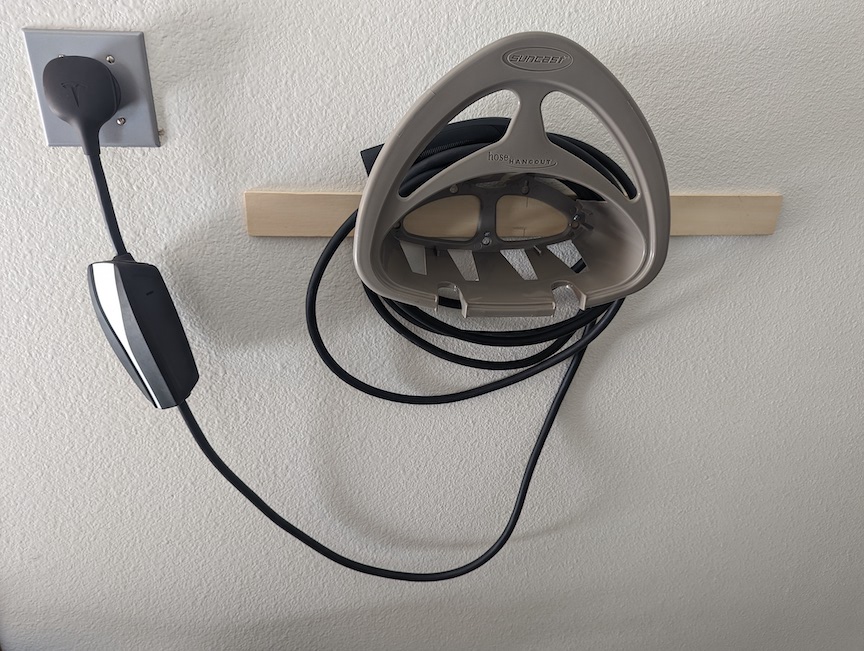
A: I didn’t. I just bought a garden hose hanger from Home Depot for $7 and it works fine. The studs didn’t line up so I had to screw a piece of wood into the wall and then the hanger into the piece of wood but it works fine for $8!
November 28, 2022
43,900 miles. I got the error messages below and obviously it looks pretty serious since the car may fail to work including the doors don’t open, windows don’t open or close, etc. I made an appointment for service with the Tesla app, but the app only makes mobile appointments as far as I can tell so I got to my nearest Tesla service center at 7:45 am so I could be the first in line. It took about 35 minutes and I was out by 8:35am. The error message means the 12v battery in the Frunk area is dead. It was $118 to replace: $85 for the battery and $25 for labor. You could do it yourself, but then you have to drive and get the battery, go home and remove and reinstall, and then drive back to the parts store to drop off the old battery for recycling. Labor was only $25 so might as well let Tesla handle it.
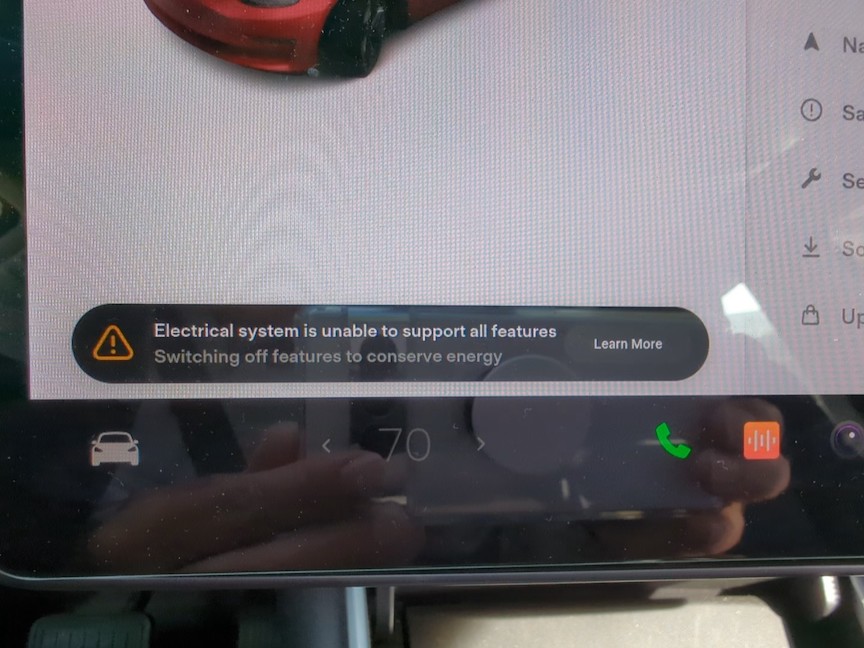
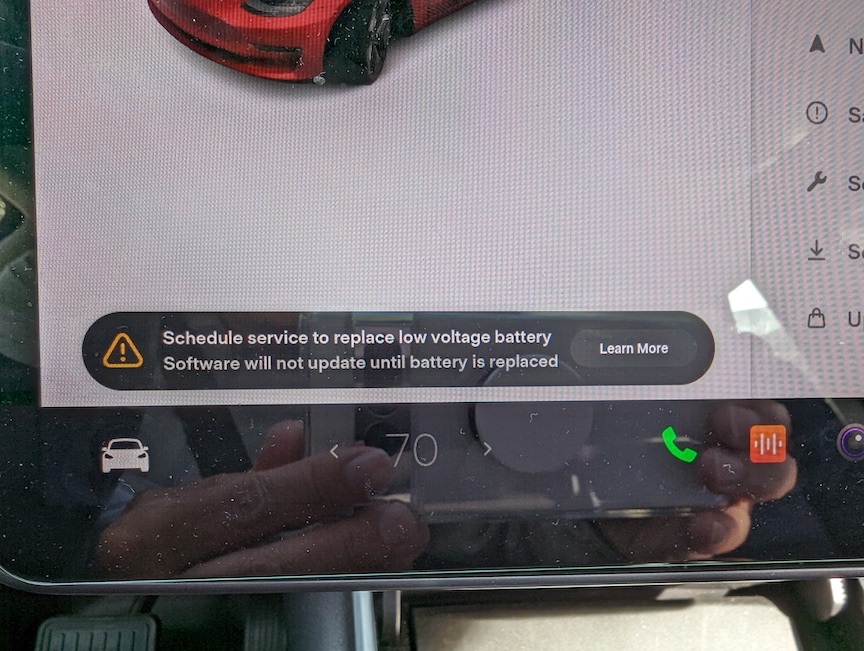
There are lithium batteries available from Ohmmu for about $400 but will the battery last 16+ years? This lead acid battery lasted 4 years and 5 months and 44,000 miles. I kind of doubt the lithium battery will last 16 years and be worth the $400, but that’s up to you to decide. I know the lithium batteries are much lighter, but is that even something worth considering? Here is how to DIY and replace the battery. For $25 it wasn’t worth me doing it myself.
Jan 3, 2023
One thing I may have not emphasized above as a reason to buy a Tesla over another EV is the actual charging plug. The Tesla charging connector plug is quite small, about the same diameter as a gasoline pump nozzle. A CCS or CHAdeMO plug connector is quite large, heavy, and more difficult to insert into your car charging port. As you can see from the image below, the Tesla plug is less than half the size of the CCS plug. The CCS plug and cable are also unwieldy, try one out when you see your next charging station. 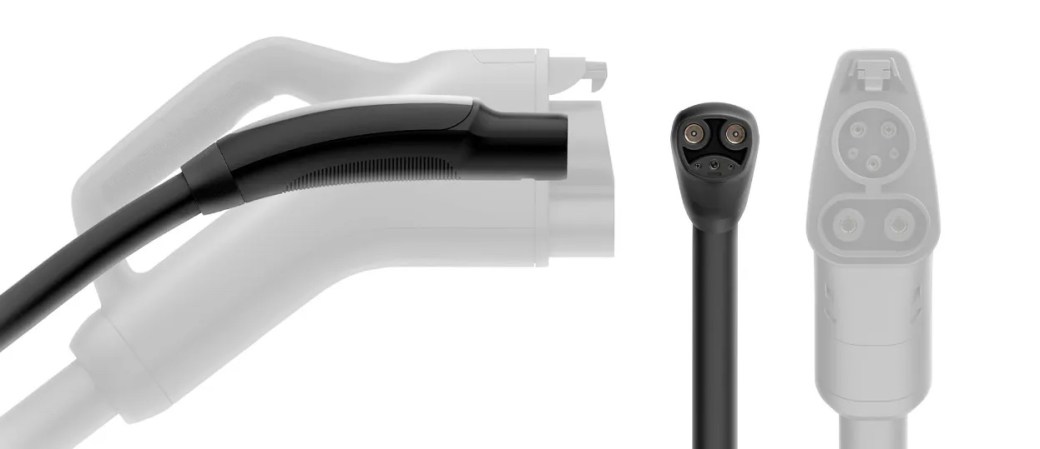 Not being able to charge may seem like a minor inconvenience but when the weather is 0F and you’re out of juice, it can be life threatening. If it’s 0F, ice may build up in your charging port, it will be a bigger deal trying to plug in a large heavier cable. When I charged my car in 0F-20F temps, I never had a problem. The charging is slower, but the car never failed to charge. This is not true for owners of non Tesla EVs. See this video below for one user’s experience. It was colder in this video than my experiences. The chargers were new and still didn’t work. There didn’t seem to be any customer support to help this guy out. The app and charger LCD screen didn’t seem to tell the user what the problem was or how to fix it. Customer Service and the app should be able to direct you to the nearest working charging station and tell you how many available stalls there are. The app should tell you that the charger is not working so you don’t waste your time driving over there and using valuable juice when you’re running low. This YouTuber describes this test as a “total disaster and the Wild West and getting worse in my opinion.” However, he said EVgo worked well. Still, if you plan on taking road trips, just get a Tesla and wait another 2-10 years until the charging infrastructure catches up to Tesla before buying a different brand EV.
Tesla opened up their charging interface specification in Nov 2022 and proposed it be used as the North American charging standard. See: Tesla opens its EV charge connector in the hope of making it the new standard. This would be a good move for the consumer and the EV industry in general. I hope there is widespread adoption of this standard, so the US and maybe globally we can all use the same charging standard just like gasoline cars.
Jan 12, 2023
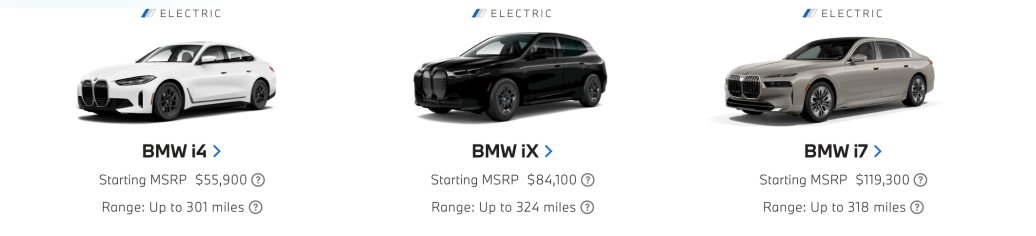
Look at what EVs BMW has to offer in 2023. All 3 cars are not exactly design award winners. The i7 and iX are just ugly. The i4 looks normal enough. Pretty surprising that BMW is having styling problems. I would guess it would be an electric car technology issue, but not a styling issue. I wonder how they are selling?
Nov 9, 2023
This page is getting rather large, so I’m starting a new one called Tesla 2023.
Todo:
- Explain Kwh, what it is, how much a typical home pays for a Kwh, how it translates to miles or rph (range per hour), how much a supercharger costs, and how much fast chargers cost, compare to mpg and do a cost per mile analysis of gas versus electricity. Wh/mile and miles per $. Someone must have done this already, just need to find it.
 Canon M Cameras