I rode extensively on 27.5″ and 29″ wheels and am firmly in the 27.5″ or 650b camp. I think every cyclist should ride both wheels sizes extensively before deciding on which one to stick with. I actually have bikes in both sizes but 29er will just be for street bikes for me from now on and 27.5″ for everything else. In 2021, bike companies are specing the majority of their mountain bikes with a 29″ wheel. I imagine since that’s what the market dictated.
The reason is that the 27.5″ wheeled bikes are easier and faster to maneuver and just feel better riding to me. This is a subjective assessment and if you’re 4’9″ you might even prefer a 26″ wheel and if 6’9″ a 29″ wheel compared to me at 5’9″ so rather than take someone else’s word for it, ride both and then decide. Note that nothing beats an extensive test ride. Buy both and ride the hell out of both of them and one should emerge as the clear winner. The constant I hear from ads and marketing people is that the 29er is faster but it’s really much more complicated than what wheel maintains momentum better. Giant had a really good technical write up on the subject and youtube has numerous videos about this topic. I will copy Giant’s page below in case it gets deleted.
1. LIGHTER WEIGHT
Significantly lower bike and rotational wheel weight helps you climb faster with less effort.
Overall Bike Weight
Compare the weights of identically equipped bikes with different wheel sizes and you’ll see substantial weight differences. As expected, the 26-inch-wheel bike is somewhat lighter than the 27.5, and substantially lighter than the 29 (up to two pounds of overall bike weight savings from 29 to 27.5). Every gram saved helps you ride faster.
Wheel/Tire Weight
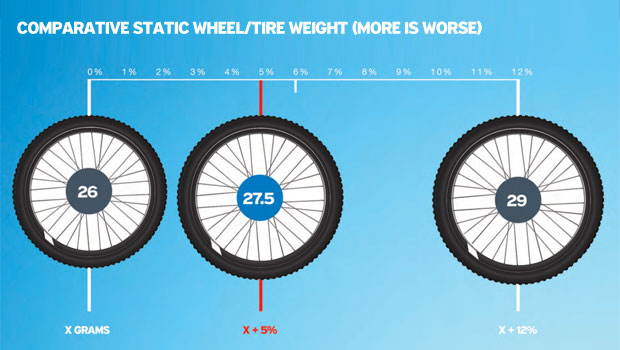
The overall weight of a 27.5 wheel set (wheel, tire and inner tube) is only 5% greater than that of an identically built 26-inch wheel set. Compare this to the 12% increase of a 29-inch wheel set and you can see how a seemingly small increase in diameter results in substantial weight gain—and poorer performance when climbing or accelerating.
Weight Comparison
Static wheel weight
Lighter wheels/tires result in a quicker acceleration and lighter overall bike weight – a win-win combination.
2. MORE EFFICIENT
Snappier acceleration and a reduced angle of attack for a smoother, more agile ride.
Rollover
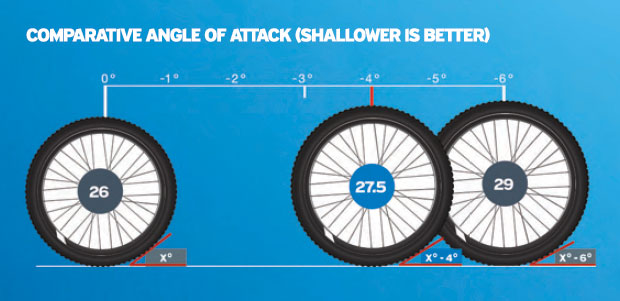
Increased wheel diameter decreases the angle of attack (the angle in which a round object intersects a square object). This is a good thing. A 29-inch wheel rolls over a 6-centimeter square-edge obstacle 14% more efficiently than a 26-inch wheel does. In comparison, a 27.5-inch wheel rolls over the same obstacle 9.8% more efficiently than a 26-inch wheel does.
Another way to analyze angle of attack is the degree of impact—where 26-inch equals X degree, 27.5 equals X-4 degrees and 29 equals X-6 degrees. Again, a shallower angle is better—so 29-inch takes the win, with 27.5 exhibiting nearly the same performance but without the weight penalty.
Acceleration
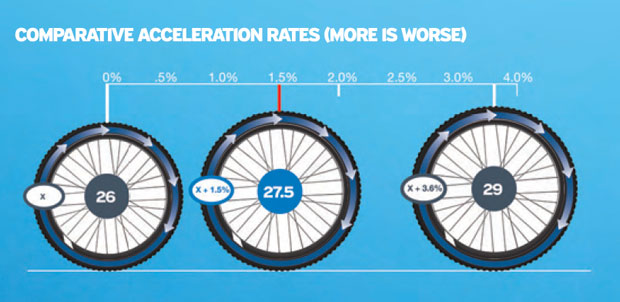
Arguably the most important benefit of 27.5 over 29 is quicker acceleration. This is the “snap” that a rider feels when they push hard on the pedals. It is affected not just by overall static weight but also where the weight is distributed throughout the wheel. The farther the weight is from the center of the hub, the slower the acceleration. So a similarly constructed 1000-gram 29-inch wheel is slower to accelerate than a 1000-gram 26-inch wheel—because the larger diameter rim and longer spokes place weight farther from the hub. The key to snappy acceleration is minimizing the weight of the outermost components (rim, nipples, spokes, tire, tube). As you can see, a 27.5-inch wheel is only 1.5% slower to accelerate than a similarly constructed 26-inch wheel, but a 29-inch wheel is 3.6% slower than a similarly constructed 26-inch wheel.
3. BETTER CONTROL
A larger tire contact patch, increased stiffness, and optimized frame geometry improve traction, braking and handling.
Traction
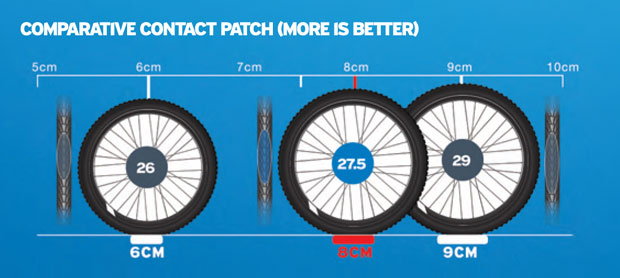
The larger the diameter of a wheel, the greater the contact patch of the tire. A larger contact patch results in better traction, which leads to improved acceleration, deceleration and cornering. As you can see, a 27.5-inch wheel has a similar contact patch to the 29.
Frame Stiffness
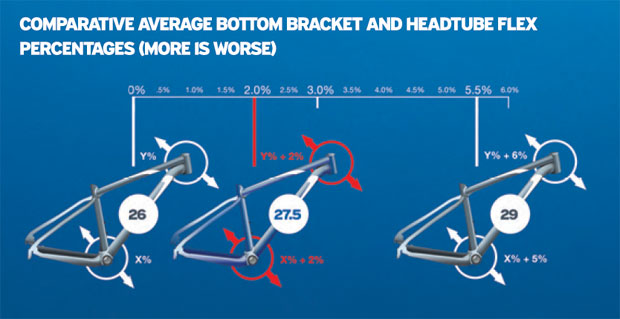
Lateral (side-to-side) frame stiffness can be affected by wheel size. To accommodate larger wheels, frame dimensions must be elongated. Therefore, a size medium 29-inch wheel frame has more lateral flex (bottom bracket and headtube) than a size medium 27.5 or 26-inch wheel frameset. Additional flex compromises handling under heavy pedaling or sharp cornering.
Frame Geometry
The larger the wheel, the more difficult it is to optimize geometry, especially on smaller frames. As the frame size decreases, headtube heights become higher (in relation to saddle height). On 26 or 27.5-inch frames, it’s less of a problem, but geometry limitations can affect smaller 29-inch-wheel frames.
 Canon M Cameras